 (281) 242-1061
  Schedule Consultation
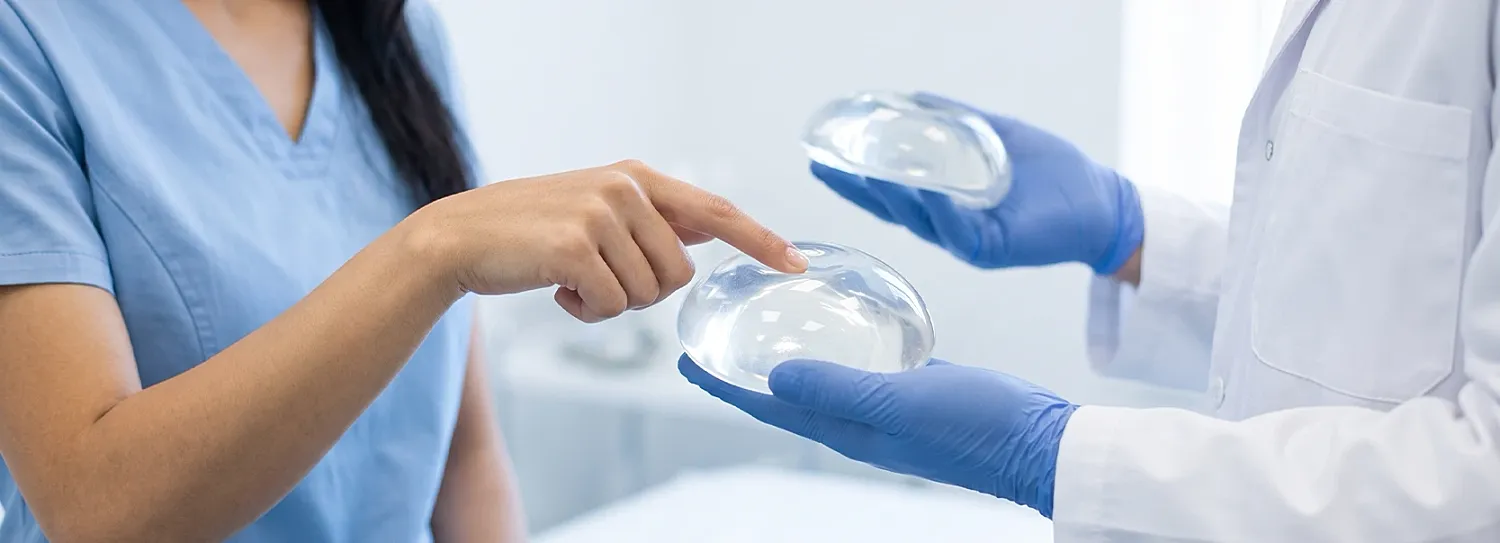
Dr. Ravi is a board-certified plastic surgeon with more than 20 years of experience and over 15,000 procedures performed. Breast implant revision recovery varies widely because revision surgery may range from a straightforward implant exchange to a more extensive procedure involving capsulectomy, pocket repair, implant repositioning, implant removal, or a breast lift.
This is one of the most important differences between revision surgery and a first-time breast augmentation. Two patients can both be having “breast implant revision,” yet their recoveries may feel completely different depending on how much scar tissue is present, whether the implant pocket needs reconstruction, whether internal support is added, and whether the breast tissues have been stretched or weakened by previous surgery.
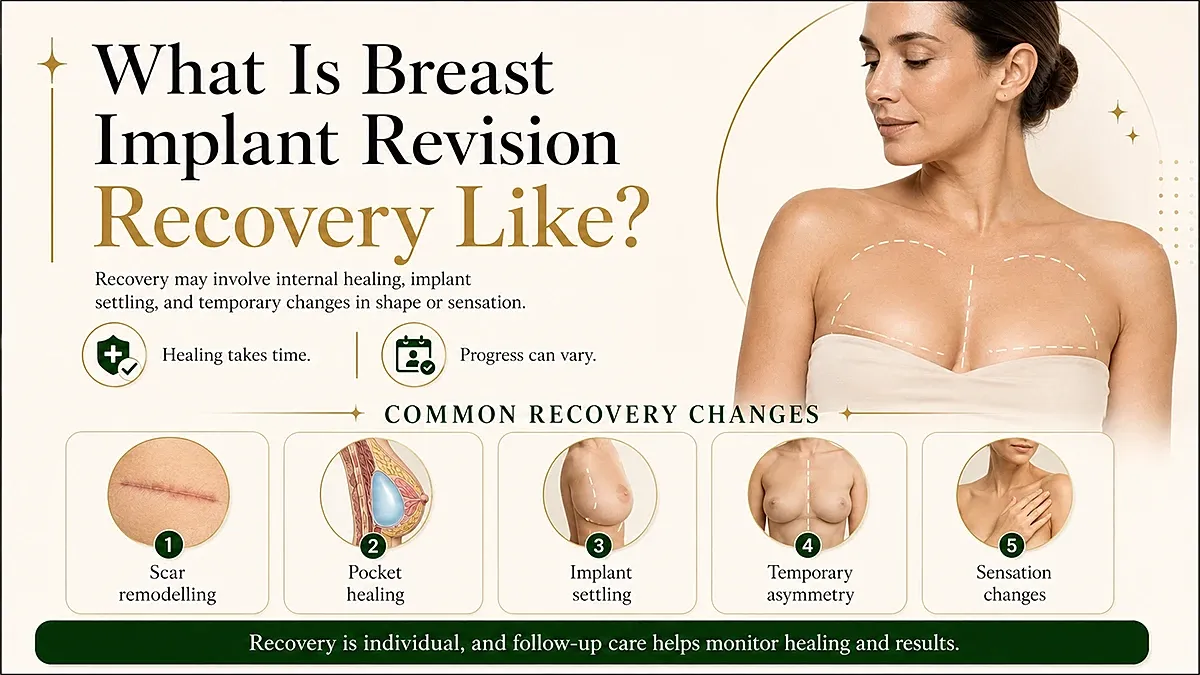
During early recovery, patients commonly notice swelling, tightness, breast firmness, incision sensitivity, temporary asymmetry, and changes in implant position. These changes usually improve gradually as swelling decreases, internal tissues remodel, and the breasts adapt to the revision.
At Body by Ravi Plastic Surgery & Associates, Dr. Ravi approaches revision recovery according to the exact procedure performed rather than using a one-size-fits-all timeline. Enhanced Recovery protocols, multimodal pain management, careful tissue handling, scar optimization, and individualized postoperative instructions are used to support healing while protecting the revised breast shape.
Many breast implant revision patients return gradually to light daily activities within approximately one to two weeks, but recovery depends heavily on the complexity of the revision. Swelling, implant settling, internal scar remodeling, and breast-shape refinement may continue for several months.
swelling, tightness, soreness, and fatigue are often most noticeable.
discomfort typically improves while breast firmness and swelling remain.
many light daily activities may resume.
activity restrictions may begin easing when healing is appropriate.
breast softness, implant position, and symmetry continue improving.
scars and final contour may continue to mature.
A simple implant exchange, capsulectomy, pocket reconstruction, implant removal, and revision with a breast lift should not be expected to have identical recovery timelines.
Breast implant revision recovery usually includes swelling, tightness, breast firmness, incision sensitivity, and temporary changes in breast shape or implant position. The amount of healing required depends on what was actually corrected inside the breast.
Functional recovery often happens earlier than complete internal healing. A patient may feel ready for work or routine activities while the implant pocket, capsule, internal sutures, and soft tissues are still stabilizing.
Surgery Day
The day of surgery is focused on recovery from anesthesia, comfort, circulation, and protecting the internal revision. Patients may notice pressure, tightness, fatigue, and a different breast shape immediately after the procedure.
The breasts may look high, swollen, firm, uneven, or simply unfamiliar on the first day. Immediate appearance should not be used to judge the final result.
Days 1–2
The first 48 hours are often when swelling, tightness, and fatigue are most noticeable. The degree of discomfort varies depending on whether the procedure involved a simple exchange or more extensive capsule and pocket work.
Patients should avoid becoming overly active simply because pain is manageable. Internal tissue healing is still in its earliest phase.
Days 3–7
By the end of the first week, soreness often improves while swelling, firmness, and breast-shape changes continue. The implants and tissues may still look different from day to day.
This is a common period for patients to monitor the breasts very closely, but daily fluctuations are usually less meaningful than overall improvement from week to week.
Week 2
The second week often brings better energy and greater independence. Patients with less complex revisions may feel ready for desk-based work, while those who had capsulectomy, pocket repair, or combined procedures may need more time.
Even when normal routines begin returning, deeper internal healing is still underway.
Weeks 3–4
By weeks three and four, the breasts often begin looking more natural as swelling decreases and tissue tension relaxes. Internal firmness may still be present, particularly after capsulectomy or pocket reconstruction.
Patients should continue following activity restrictions based on the exact work performed during revision surgery.
Weeks 4–6
During weeks four through six, many patients begin transitioning toward a broader range of physical activity. The timeline is highly individualized because a simple implant exchange may allow a different progression than a repaired implant pocket or extensive capsule removal.
Comfort alone should not determine return to heavy exercise. The implant pocket and internal repairs may still need protection.
Months 2–3
By months two and three, many revision patients see meaningful improvement in breast softness, implant position, symmetry, and overall contour. This is often when the result begins to feel less like a postoperative change and more like the intended long-term shape.
Revision results should still be viewed as evolving during this period, especially when significant pocket or capsule work was performed.
Months 6–12
Long-term refinement can continue for six to twelve months or longer. Scar maturation, subtle implant settling, and soft-tissue remodeling may continue even after patients feel completely recovered.
Revision surgery often requires more patience than primary augmentation because the tissues are adapting not only to a new implant or position but also to the effects of previous surgery.

Revision recovery can feel very different from a first breast augmentation because the tissues have already undergone surgery and may contain scar tissue, stretched skin, altered implant pockets, or previous internal changes. The amount of revision work matters more than the fact that an implant is being replaced.
Some patients find a straightforward implant exchange easier than their first augmentation, while others experience a longer recovery because more internal correction was required. Comparisons with the first surgery are therefore not always useful.
A simple implant exchange may involve less internal reconstruction than more complex revision surgery, so recovery can sometimes be relatively straightforward. Even so, swelling, firmness, incision healing, and implant settling still require time.
A straightforward exchange may allow faster functional recovery than capsulectomy or pocket reconstruction. The final breast contour still develops gradually as tissues adjust to the new implants.
Recovery after capsulectomy may involve more swelling, tightness, and internal soreness because some or all of the capsule surrounding the implant has been removed. The breast tissues then need time to heal and remodel in addition to adapting to any implant replacement or repositioning.
Early firmness after capsulectomy does not automatically mean capsular contracture has returned. Persistent or increasing hardness, pain, distortion, or implant displacement should be evaluated clinically rather than self-diagnosed.
Pocket revision often requires more protection during recovery because internal sutures or tissue adjustments are used to stabilize the implant in a new position. Patients may be asked to limit certain movements longer than after a simple implant exchange.
Implant position should be judged over time rather than during the first few postoperative weeks. Internal repairs need time to strengthen before the revised pocket is subjected to heavy physical stress.

Recovery after implant removal focuses on allowing the breast tissues and skin to adapt after the volume of the implant is removed. The breasts may initially look deflated, irregular, or different from the eventual result because swelling and tissue contraction occur gradually.
If implant removal is combined with a lift or other reshaping procedure, recovery becomes more involved. Patients considering explantation should review the dedicated Breast Implant Removal information for procedure-specific details.

A revision that includes a breast lift involves additional skin and soft-tissue healing because the breast is being reshaped as well as revised around the implant. This can extend the scar-healing and breast-settling process.
Patients undergoing this combination should expect recovery to reflect both revision surgery and mastopexy healing. Detailed lift-plus-implant recovery guidance is better addressed in the dedicated Breast Augmentation With Lift Recovery guide.
Swelling after breast implant revision usually improves gradually over the first several weeks, but smaller amounts may persist longer depending on the complexity of the surgery. Capsulectomy, pocket repair, and combined procedures can create more internal inflammation than a simple exchange.
Gradual improvement is generally reassuring. Sudden one-sided swelling, increasing pressure, heat, redness, or worsening pain should be reported promptly.
Swelling can appear more noticeable later in the day because of activity, gravity, fluid shifts, heat, and prolonged time upright. This pattern usually becomes less obvious as the tissues heal.
Yes, particularly when one breast required more capsule or pocket correction than the other. Mild uneven swelling can be normal, but a sudden dramatic difference should be evaluated.
One breast can heal faster because revision surgery is often asymmetric by nature. One side may contain more scar tissue, require greater pocket correction, or have different pre-existing skin and tissue quality.
Patients should focus on overall progression rather than expecting both breasts to change each day identically. Sudden new asymmetry associated with pain, swelling, or implant movement should be reported.
Breast firmness after revision surgery is often related to swelling, internal sutures, implant-pocket healing, and normal scar-tissue remodeling. Firmness can be especially noticeable after capsulectomy, pocket repair, implant repositioning, or other procedures that involve more extensive internal correction.
Gradual softening over time is generally reassuring. Because revision surgery often involves previously operated tissues, the breasts may take longer to feel completely natural than they did after a straightforward primary augmentation.
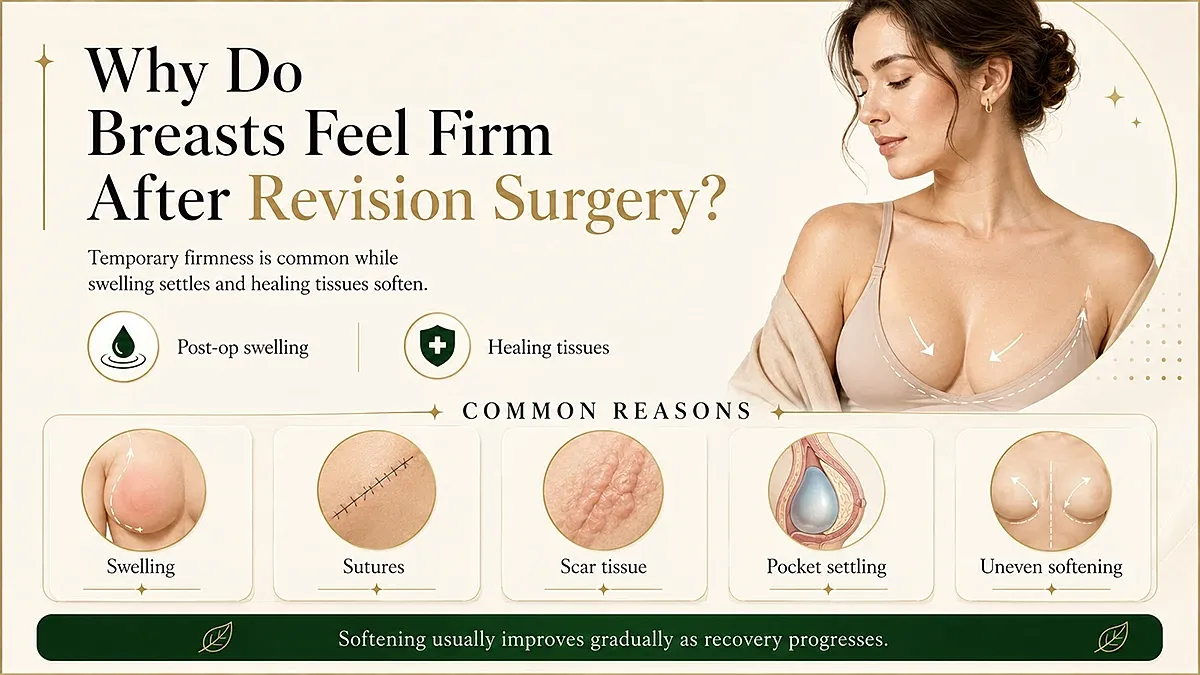
Early firmness is common and does not automatically mean capsular contracture has developed or returned. Firmness that progressively increases, becomes painful, distorts the breast, or changes implant position should be evaluated by the surgical team rather than diagnosed at home.
A breast that is steadily becoming softer generally follows a different pattern from one becoming increasingly hard or distorted. Any concerning change should be discussed with Body by Ravi Plastic Surgery & Associates so the cause can be assessed clinically.
New implants gradually settle as swelling decreases, the implant pocket stabilizes, muscle tension relaxes, and surrounding tissues adapt to the revised breast shape. The settling process can differ substantially from a patient's first augmentation because the pocket may have been tightened, expanded, reconstructed, or cleared of scar tissue.
Meaningful settling often becomes more apparent over the first several months. The final implant position should be judged after the tissues have had adequate time to heal rather than during the first few weeks.
Yes, one implant can settle faster because each side may have required a different amount of pocket correction, capsule removal, or tissue repair. Temporary differences in implant height or breast softness can therefore occur even when recovery is progressing normally.


Revision surgery may intentionally change implant size, profile, pocket position, or breast support, so the new implants are not necessarily expected to settle exactly like the previous pair. Early swelling and tissue tension can further exaggerate these differences before the final contour develops.
Back sleeping with the upper body elevated is commonly recommended during early breast implant revision recovery because it reduces direct pressure on the breasts and can make swelling and tightness more comfortable. Exact instructions depend on whether the surgery involved implant exchange, capsulectomy, pocket repair, internal support, or additional breast lifting.
Sleeping recommendations should reflect the internal revision rather than simply how comfortable a position feels. Patients should wait for Dr. Ravi's clearance before returning to positions that place sustained pressure on the breasts.
Side sleeping should generally wait until the breasts and internal repairs have healed enough to tolerate asymmetric pressure. Patients who underwent significant pocket reconstruction may require different restrictions than those who had a straightforward implant exchange.
Stomach sleeping places direct pressure on both breasts and is usually resumed later than back or side sleeping. Dr. Ravi will advise when the implant pockets, incisions, and breast tissues are sufficiently healed for this position.

The appropriate postoperative bra depends on the type of breast implant revision performed. A support garment can reduce unnecessary breast movement, improve comfort, protect incisions, and help support a revised implant pocket while internal tissues heal.
Some revisions require more specific implant-position support than others. A bra that was appropriate after a previous augmentation may not necessarily be the right garment after pocket repair or implant repositioning.
A sports bra may become appropriate after early healing, but patients should wait for clearance because some styles compress the implants or place pressure on healing incisions. The best transition depends on implant position, incision healing, and the internal revision performed.
The duration varies according to the procedure and tissue support needs. Dr. Ravi will determine when the breasts are stable enough to reduce garment use or transition to regular supportive bras.
Exercise should return gradually after breast implant revision because the timing depends on what was repaired inside the breast. A simple implant exchange may permit a different progression than capsulectomy, pocket reconstruction, internal bra placement, or revision combined with a breast lift.
✓ Walking
Gentle walking is usually encouraged early to support circulation and reduce stiffness. Early walks should remain easy rather than becoming strenuous exercise.
✓ Light Cardio
Low-impact cardiovascular exercise may return once early healing is progressing appropriately. Patients should reduce activity if it causes increased breast swelling, throbbing, or discomfort.
✓ Running
Running creates repetitive breast movement and should generally return later than walking or low-impact cardio. Patients should have adequate healing, appropriate breast support, and Dr. Ravi's clearance before returning to impact exercise.
✓ Lower-Body Exercise
Selected lower-body exercises may be introduced before upper-body training, but heavy weights can still require significant chest and core stabilization. Lower-body exercise should therefore progress gradually rather than assuming it places no strain on the revised breasts.
✓ Upper-Body Exercise
Upper-body training requires more caution because pushing, pulling, reaching, and lifting can stress the chest and implant pockets. Pocket repair or submuscular implant work may require a slower progression.
✓ Planks and Core Work
Planks and similar exercises recruit the chest, shoulders, and upper-body stabilizers even though they are commonly considered core movements. Patients should wait for clearance before returning to planks, side planks, mountain climbers, or comparable exercises.
✓ Weight Training
Weight training should restart with lighter resistance after sufficient healing. Patients should increase loads progressively while monitoring breast tightness, swelling, and discomfort.
✓ Push-Ups and Chest Exercises
Push-ups, bench press, chest flyes, and other pectoral exercises typically return later because they directly load tissues around the implant pocket. This is particularly important when the revision involved submuscular implants or pocket reconstruction.
Feeling strong enough to exercise does not mean the internal repair is fully healed. Returning gradually helps protect implant position and internal sutures while the revised pocket stabilizes.

Return-to-work timing depends primarily on the complexity of the revision and the physical demands of the job. Many patients with uncomplicated revisions return to light desk-based work within approximately one to two weeks, while more complex revisions or physical occupations may require additional recovery.
✓ Desk-Based or Remote Work
Desk and remote work can often resume earlier because they involve minimal lifting and upper-body strain. Patients should still be able to work comfortably without sedating medication and take periodic walking breaks.
✓ Active Jobs
Jobs involving prolonged standing, frequent reaching, repetitive arm use, or continuous movement may require more recovery time. Activity should not repeatedly pull on incisions or stress a repaired implant pocket.
✓ Heavy Physical Jobs
Occupations involving lifting, pushing, pulling, restraining, climbing, or substantial upper-body effort generally require the longest recovery period. Returning prematurely may increase swelling or strain internal repairs.
Procedure complexity matters more than the label "revision." Dr. Ravi provides individualized return-to-work guidance based on what was corrected and how healing is progressing.

Driving can resume when patients are no longer taking narcotic or sedating medication and can control the vehicle normally without pain or hesitation. The ability to react safely in an emergency matters more than reaching a specific postoperative day.
Before driving, patients should be able to:
If chest movement or arm motion remains restricted, driving should wait until those movements are comfortable and safe.
Sexual activity should return gradually because it can increase heart rate, blood pressure, breast movement, and pressure on the healing implant pockets. Patients who underwent pocket repair, capsulectomy, or internal support may need to be particularly careful about direct breast pressure during early recovery.
There is no single timeline that applies to every revision procedure. Dr. Ravi can advise when increasingly strenuous activity is appropriate based on the internal repair.
Gentle contact may become comfortable as tenderness and swelling decrease, but firm pressure or vigorous manipulation should wait until the breasts are more fully healed. Patients should also avoid implant massage unless specifically instructed because some pocket repairs are intentionally designed to limit implant movement.
A balanced diet with adequate protein, hydration, fiber, and micronutrients supports the body's normal healing processes. Revision recovery is generally not the ideal time for aggressive calorie restriction or rapid weight loss.
Nutrition cannot guarantee faster healing, but adequate intake gives the body the resources needed for normal wound and tissue repair.
Patients should avoid habits that can interfere with healing or increase postoperative problems.
All medications and supplements should be reviewed with the surgical team because some can affect bleeding or interact with postoperative medications.
Breast implant revision often uses an existing incision when appropriate, although some procedures require additional or modified incisions. Early scars may appear pink, red, firm, itchy, or sensitive before gradually softening and fading.
Patients should judge revision scars over months rather than weeks. Previously operated tissues can sometimes heal differently from tissue undergoing surgery for the first time.
Dr. Ravi's scar strategy begins with careful incision planning, meticulous closure, and reducing unnecessary tension on the healing skin. Postoperative scar treatment is individualized according to incision type and the patient's healing pattern.
Additional therapies may be considered selectively as scars mature. No technique can make an incision completely scar-free, but a structured approach can help optimize scar quality.
Most swelling, firmness, bruising, and temporary asymmetry improve as expected, but some changes require prompt evaluation. Patients should contact Body by Ravi Plastic Surgery & Associates when symptoms become sudden, progressively worse, or substantially different from their expected recovery.
Contact the surgical team promptly for:
Seek emergency medical attention for:
Patients should not wait for a scheduled postoperative visit when a symptom feels urgent. Prompt assessment can distinguish a normal recovery change from a problem requiring treatment.
Preparing transportation, meals, sleeping arrangements, and household support before surgery can also make the early recovery period significantly easier.
Certain habits can increase swelling, stress internal sutures, interfere with scar healing, or place unnecessary pressure on a reconstructed implant pocket. Patients may feel well before these deeper tissues are ready for unrestricted activity.
Protecting the internal repair during early recovery is especially important after pocket correction or implant repositioning. A few extra weeks of caution can be more appropriate than rushing back to activities based only on how comfortable the breasts feel.
Breast implant revision recovery is highly individualized because the amount of healing depends on what was corrected during surgery. A simple implant exchange may involve a different recovery than capsulectomy, pocket repair, implant repositioning, implant removal, or revision combined with a breast lift.
Breast implant revision recovery should be judged according to the work performed inside the breast rather than simply by whether an implant was exchanged or replaced.
Dr. Ravi is a board-certified plastic surgeon with more than 20 years of experience and over 15,000 procedures performed. His approach to breast implant revision emphasizes tissue-based planning, careful management of existing scar tissue and implant pockets, Enhanced Recovery protocols, scar optimization, and natural-looking breast proportions.
His operating team includes a board-certified anesthesiologist, skilled nurses, and an experienced plastic surgery first assist. Procedures are performed in a QuadA-accredited surgical environment, with postoperative guidance tailored to the specific revision rather than applying the same recovery protocol to every patient.

A personalized consultation can help determine what breast implant revision recovery may involve based on your previous surgical history, existing implants, scar capsule, implant pocket, breast tissue quality, and the type of correction needed.
Schedule a consultation with Dr. Ravi at Body by Ravi Plastic Surgery & Associates in Houston, TX, to discuss your revision options, expected healing timeline, activity restrictions, implant-settling process, and postoperative scar plan.
Revision surgery can feel tighter because existing scar tissue, pocket reconstruction, internal sutures, or capsule work may create more internal tension than a straightforward primary augmentation. The sensation usually improves as swelling decreases and the revised tissues soften.
Yes, one breast can heal faster because each side may require a different amount of scar-tissue removal, pocket repair, or implant repositioning. Mild asymmetry is common early, but sudden swelling, increasing pain, or a dramatic new difference should be reported.
New implants usually settle gradually over several weeks to months as swelling decreases and the implant pocket stabilizes. The timeline can differ from your original augmentation because the pocket may have been tightened, expanded, or otherwise revised.
Breast shape can change from week to week because swelling, internal scar remodeling, implant position, and soft-tissue adaptation are still evolving. Revision results are better judged over months rather than from day-to-day changes.
Firmness can persist for several weeks or longer after capsulectomy because the breast is healing from additional internal tissue work and scar remodeling. Gradual softening is generally reassuring, while increasing hardness, pain, distortion, or implant displacement should be evaluated.
Yes, pocket repair can make recovery feel tighter or more restricted because internal sutures may be used to stabilize the implant in a new position. Activity restrictions may also be more cautious while those internal repairs strengthen.
Side sleeping should usually wait until the breasts and any internal pocket repairs have healed enough to tolerate uneven pressure. Dr. Ravi will provide individualized clearance based on the type of revision performed and your healing progress.
Running, planks, push-ups, and chest-focused exercises should return gradually because they can stress the implant pocket, chest muscles, and healing internal sutures. Timing depends on whether your revision involved a simple exchange, capsulectomy, pocket repair, submuscular implants, or additional breast lifting.
Early firmness is common after revision surgery and often improves as swelling and scar tissue soften. Increasing hardness, progressive distortion, pain, or a noticeable change in implant position should be evaluated by Body by Ravi Plastic Surgery & Associates rather than self-diagnosed.
Most patients see meaningful improvement within the first few months, but implant settling, scar remodeling, breast softness, and symmetry can continue changing for six to twelve months. The final result should be judged after the tissues have had enough time to stabilize, especially after more complex revision surgery.
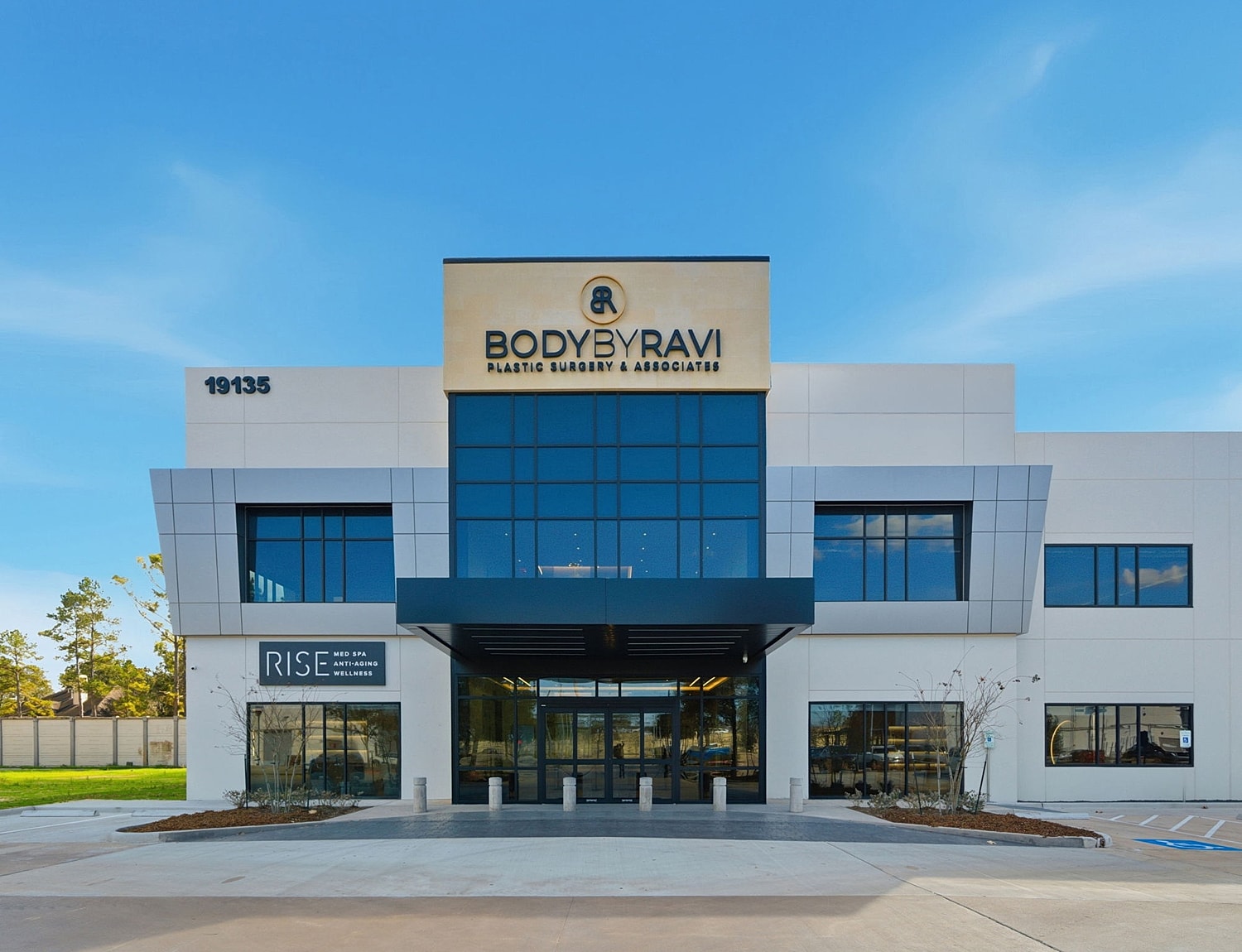

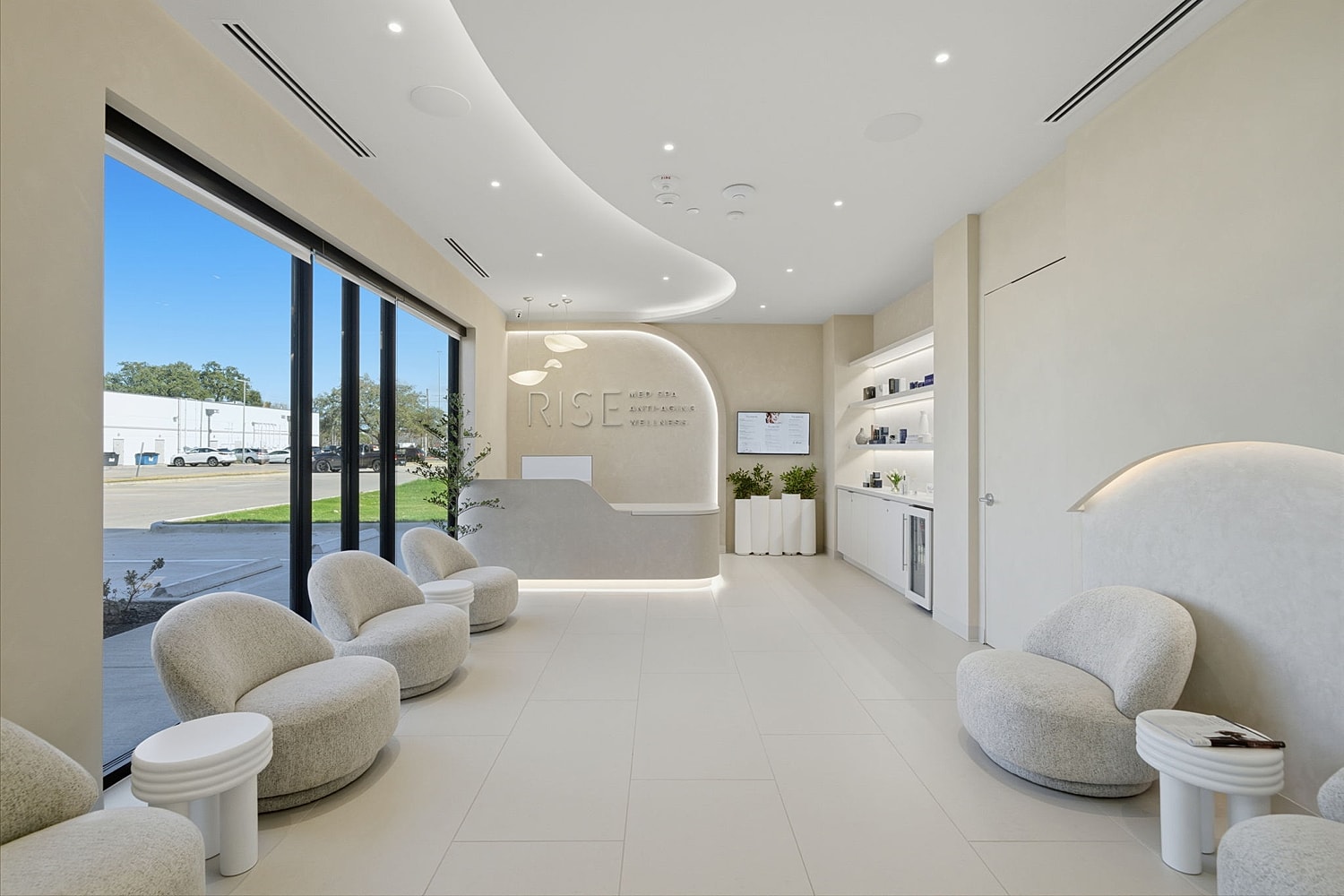

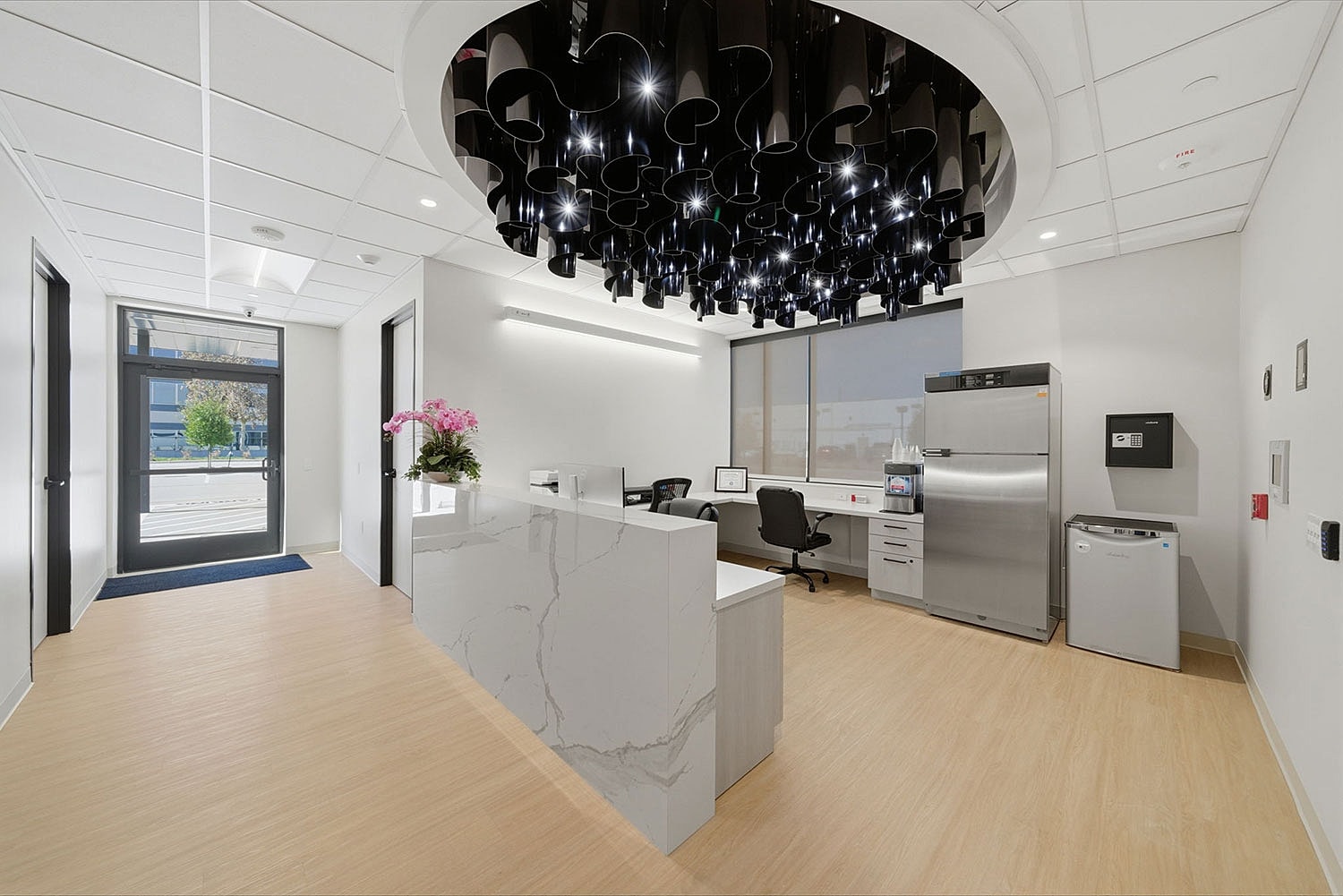
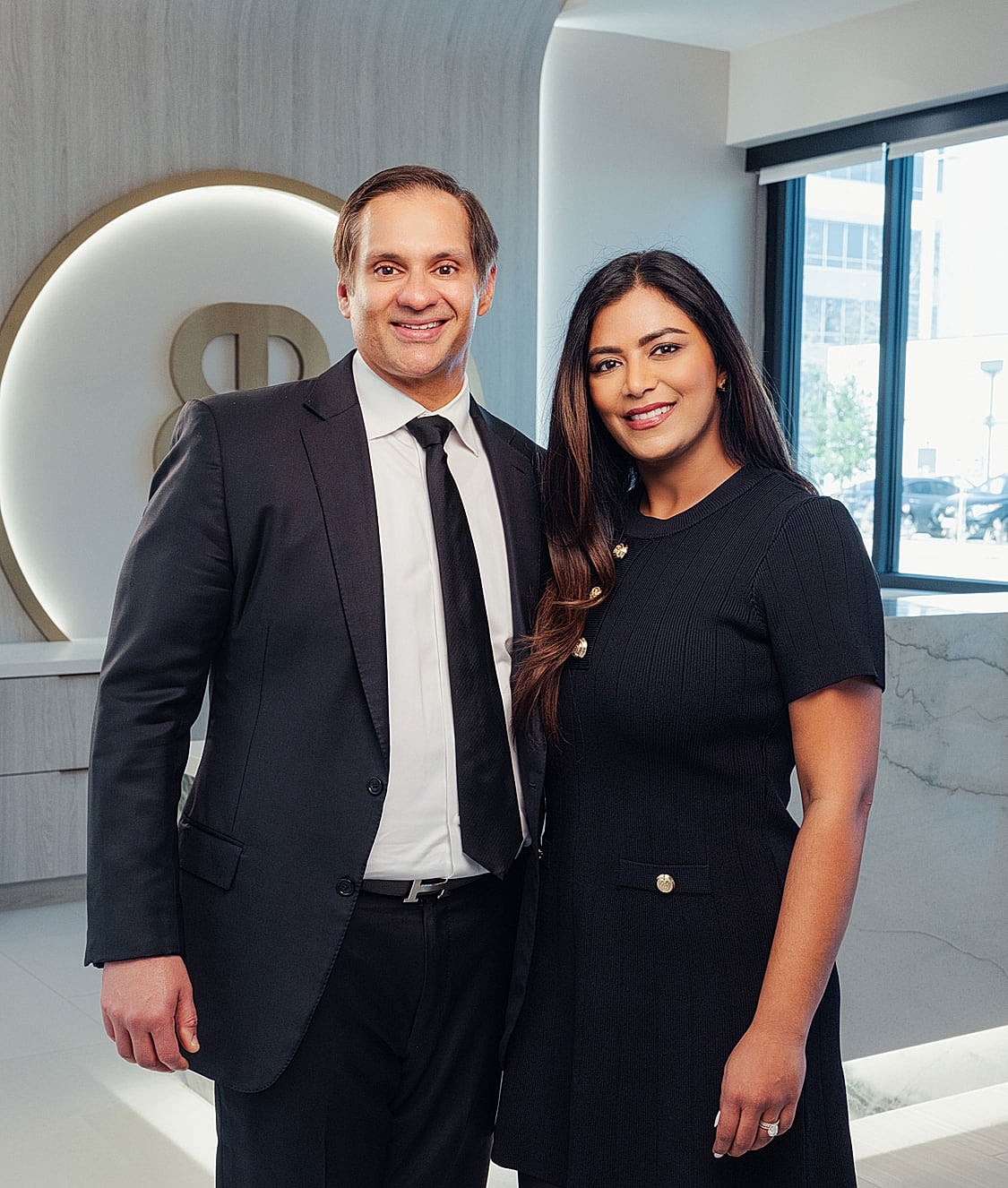
Dr. Ravi Somayazula and Dr. Swapna Gopathi are Board-Certified Physicians who use a patient-centered approach and spend as much time as needed to make each patient feel special and respected—not just another person walking through the door.
As a team, a one-of-a-kind treatment plan is created to address concerns from head to toe with the latest surgical and non-surgical techniques, including: Breast Augmentation (Implants), Tummy Tucks, Liposuction, Mommy Makeovers, miraDry®, Botox®, Dermal Fillers, and AVÉLI ® Cellulite treatment.
Working side-by-side, Dr. Ravi and Dr. Gopathi strive to create a long-lasting relationship with each patient, meeting any new aesthetic needs as they arise. Together, the staff at Body by Ravi Plastic Surgery & Associates take each patient step-by-step through their cosmetic journey to achieve the desired aesthetic results.