 (281) 242-1061
  Schedule Consultation
Published
11 minute read
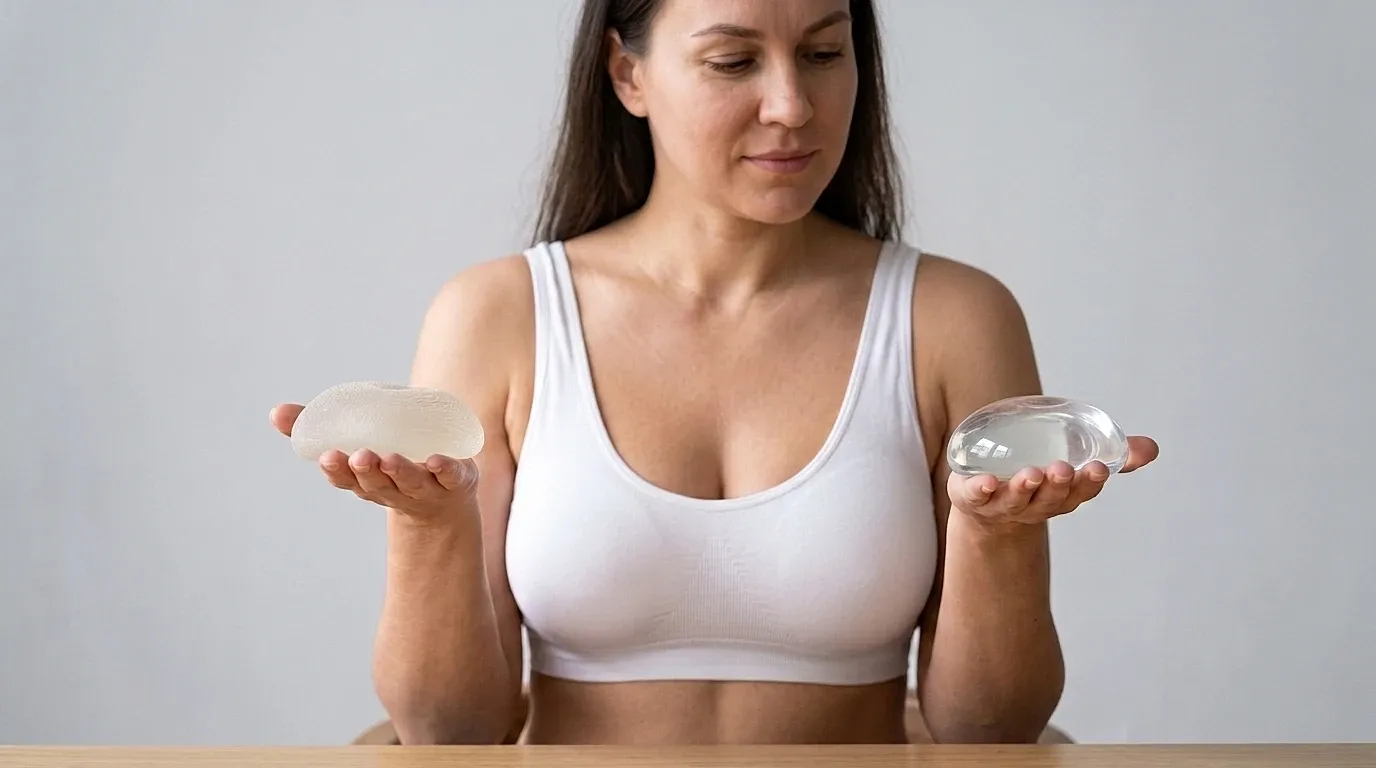
Breast augmentation has become a far more thoughtful conversation than it was in years past. Patients are no longer focused only on cup size or whether they want to be “bigger.” Many are thinking about proportion, softness, implant feel, recovery, muscle function, long-term maintenance, and how to choose a surgical approach that truly fits their anatomy. They want to understand not only what can be done, but what should be done. They want results that feel elegant, natural-looking, and aligned with their body rather than driven by trends.
That is exactly why newer conversations around Motiva Preservé have gained attention. Patients hear terms like tissue-preserving, less disruptive, and recovery-conscious, and naturally they want to know how that compares with traditional breast augmentation techniques. They want to know whether this newer option is truly better, whether it is safer, whether it creates a more natural result, and whether it might be a better fit for their lifestyle.
At Body by Ravi Plastic Surgery & Associates in Houston, that question is approached with balance. Dr. Ravi Somayazula does not believe breast surgery decisions should be made around hype or marketing language. He believes they should be made through careful listening, sound surgical judgment, and a clear understanding of the patient’s anatomy and goals. In his view, the best breast augmentation plan is never the one that sounds the newest. It is the one that best serves the patient sitting in front of him.
For some women, that recommendation may include Motiva Preservé. For others, a more traditional augmentation technique may still be the most appropriate and refined option. The real goal is not to force every patient into one philosophy. The goal is to create a plan that looks beautiful, feels balanced, and respects the body over time.
Today’s breast augmentation patient is usually much more informed. She often arrives at consultation having spent weeks or months researching implant options, incision placement, recovery expectations, and newer techniques. She may have watched videos, looked at before-and-after photos, and compared different terms she has seen online. But even with that research, many patients still feel uncertain because they are trying to sort through a great deal of information that may not always be well explained.
That is why consultation matters so much. A patient may come in asking about Motiva Preservé, but the real concern underneath the question is often broader. She may be wondering whether she can achieve a natural result without looking obviously augmented. She may be concerned about downtime because she has children at home, a demanding job, or a travel schedule that does not allow for prolonged recovery. She may be an active woman who values chest strength and wants to understand whether muscle involvement matters. She may be restoring fullness after pregnancy or weight loss and wants to feel feminine again without appearing overdone.
These are thoughtful concerns. They reflect how much more nuanced cosmetic breast surgery has become.
Patients commonly want to understand:
Those are the right questions to ask. The answers, however, are rarely one-size-fits-all.
A successful breast augmentation is never just about choosing a device. It is about building a complete surgical plan around the patient’s body. Implant size matters, but it is only one variable in a much larger equation. Breast width, soft tissue thickness, skin elasticity, nipple position, chest wall characteristics, and the amount of natural breast volume all shape what kind of result is realistic and attractive.
That is one of the biggest misconceptions patients have when they begin researching surgery. They often assume that the implant is the main decision. In reality, the implant is only one component. The pocket strategy matters. Tissue support matters. The overall shape matters. Long-term stability matters. Even the patient’s lifestyle plays an important role.
A patient who works out heavily may have different concerns than someone who is less physically active. A patient with naturally tight skin may have different options than someone whose breast tissues have changed after pregnancy or significant weight loss. A patient who wants a very modest enhancement is not looking for the same solution as someone who wants more visible upper-pole fullness or a broader size increase.
This is where thoughtful surgical planning separates a tailored result from a generic one.
Motiva Preservé breast augmentation has drawn attention because it is described as a more tissue-conscious approach to breast enhancement. For many patients, that language immediately resonates. It suggests that the procedure is designed with greater respect for the body’s natural anatomy and with an emphasis on minimizing unnecessary disruption.
That concept is appealing, especially to patients who are seeking subtle enhancement rather than an obvious transformation. It may also appeal to patients who want to preserve a more natural feel, maintain natural movement, or support a smoother early recovery. Women who are fitness-focused often pay close attention to whether the chest muscles are involved. Women pursuing their first augmentation may be especially drawn to an approach that sounds more measured and refined.
In broad terms, Motiva Preservé is often discussed as an option for selected patients who want:
Those are all understandable priorities. But as appealing as this may sound, it is important to keep the conversation balanced. Motiva Preservé is not automatically the best option for every patient. It is not a universal replacement for traditional augmentation. It is one potential option within a larger framework of breast surgery planning.
That is an important distinction. In aesthetic surgery, the best operation is not the one with the best name. It is the one that fits the patient’s anatomy, goals, and long-term needs most appropriately.
Many patients today are looking for refinement, not exaggeration. They want to look like themselves, only better balanced. They want their clothing to fit beautifully, their silhouette to feel more feminine, and their confidence to improve, but they do not necessarily want a dramatic or obviously surgical look.
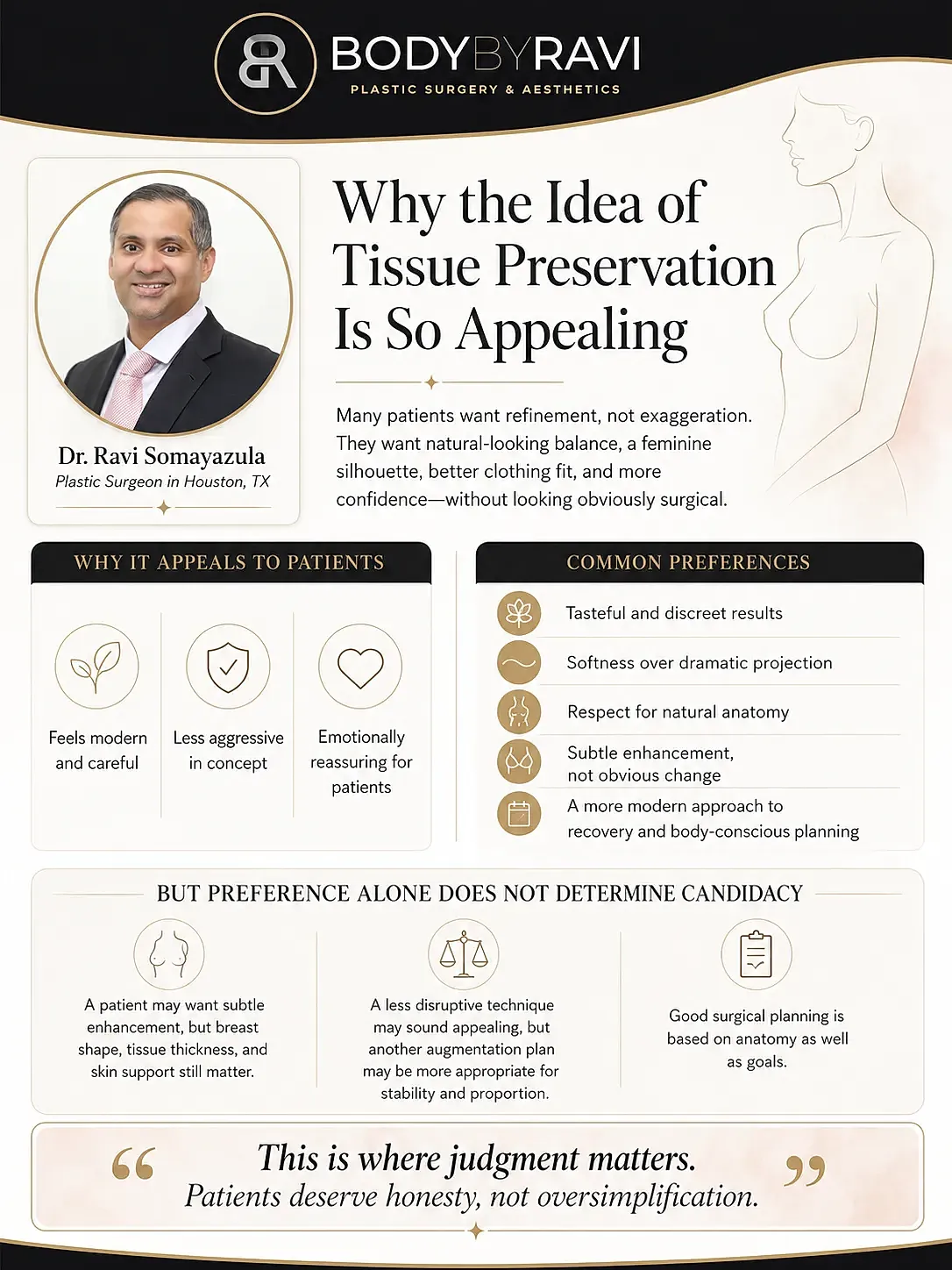
That is one reason the idea of tissue preservation has become so compelling. It feels modern. It feels careful. It feels less aggressive. And for many women, especially those who have spent a long time deciding whether surgery is right for them, that matters emotionally as much as it does physically.
Patients who are drawn to Motiva Preservé often share similar preferences:
Still, those preferences do not determine candidacy on their own. A patient may want a subtle enhancement, but her breast shape, tissue thickness, or skin support may still make another approach more appropriate. Likewise, a patient may love the idea of a less disruptive technique, yet still need the versatility of a more traditional augmentation plan to achieve a stable and proportionate result.
This is where judgment matters. Patients deserve honesty, not oversimplification.
Traditional breast augmentation remains deeply relevant because it offers flexibility and has been refined through years of surgical experience. It is not outdated. It is not unsophisticated. In many cases, it remains the more suitable and more effective option.
That matters because newer techniques can sometimes create the impression that everything older is somehow less advanced. In reality, traditional breast augmentation is still a highly nuanced and customizable procedure. It may offer the surgeon more latitude in addressing different implant sizes, pocket strategies, asymmetries, tissue variations, and aesthetic goals.
A traditional approach may be especially helpful for patients who want:
For these patients, traditional augmentation may not only be appropriate, but preferable. It can provide the structure and adaptability necessary to create a result that is not only beautiful at first, but also stable and proportionate over time.
Dr. Ravi views traditional techniques with respect because they remain essential tools in aesthetic breast surgery. When chosen thoughtfully and performed precisely, they can produce very natural-looking and elegant outcomes. Traditional does not mean generic. It means established, versatile, and still highly valuable.
Patients often want a simple answer when they compare procedures. They want one option to emerge as clearly superior. But breast augmentation rarely works that way.
The better question is not which technique is better in the abstract. The better question is which technique is better for this specific patient.
That change in framing is important because it moves the conversation away from marketing and back to medicine. It encourages a more individualized way of thinking. It allows a surgeon to evaluate not just what a patient likes the sound of, but what will genuinely serve her body and goals.
For example, one patient may have naturally small breasts, good skin tone, favorable tissue support, and a desire for a subtle enhancement that simply improves balance. She may be a very good candidate for a more tissue-conscious approach.
Another patient may have more volume loss after pregnancy, thinner tissues, visible asymmetry, or a desire for more upper-pole fullness. She may be better served by a traditional augmentation technique, or by a combination of augmentation and lift.
Another patient may need a plan that includes internal support, hybrid fat transfer, or a more customized strategy because of her anatomy or past changes.
These are very different scenarios. That is why no meaningful recommendation can be made in isolation from the patient herself.
Breast augmentation recovery is understandably one of the first things patients ask about. Women considering breast augmentation are often trying to plan surgery around busy lives. They may have children who need lifting and care. They may have work obligations that limit downtime. They may have exercise routines they want to return to, vacations planned, or important events on the calendar.
Because of that, the appeal of a more recovery-conscious technique is real.
Motiva Preservé is often discussed in that context because a tissue-conscious approach may help support a smoother early recovery for selected patients. That possibility can be very attractive, especially to women who want modest enhancement and are hoping for a surgical plan that feels more aligned with real life.
But recovery should never be isolated from the bigger picture. A patient should not choose a technique simply because it sounds easier if that technique is not the best match for her anatomy or goals. A short-term recovery advantage means very little if the surgery does not create the shape, support, or fullness that the patient actually wants.
Recovery is also influenced by more than the name of a technique. It may depend on:
That is why Dr. Ravi places value on the full recovery process, not just the label attached to a procedure. Careful planning, detailed instructions, and close follow-up all matter. The best recovery is supported by good surgery, but also by good perioperative care.


Published
3 minute read
One of the most common misunderstandings in breast augmentation is the belief that a natural-looking result comes from a particular brand name or a single modern technique. In reality, natural-looking outcomes come from proportion and thoughtful planning.
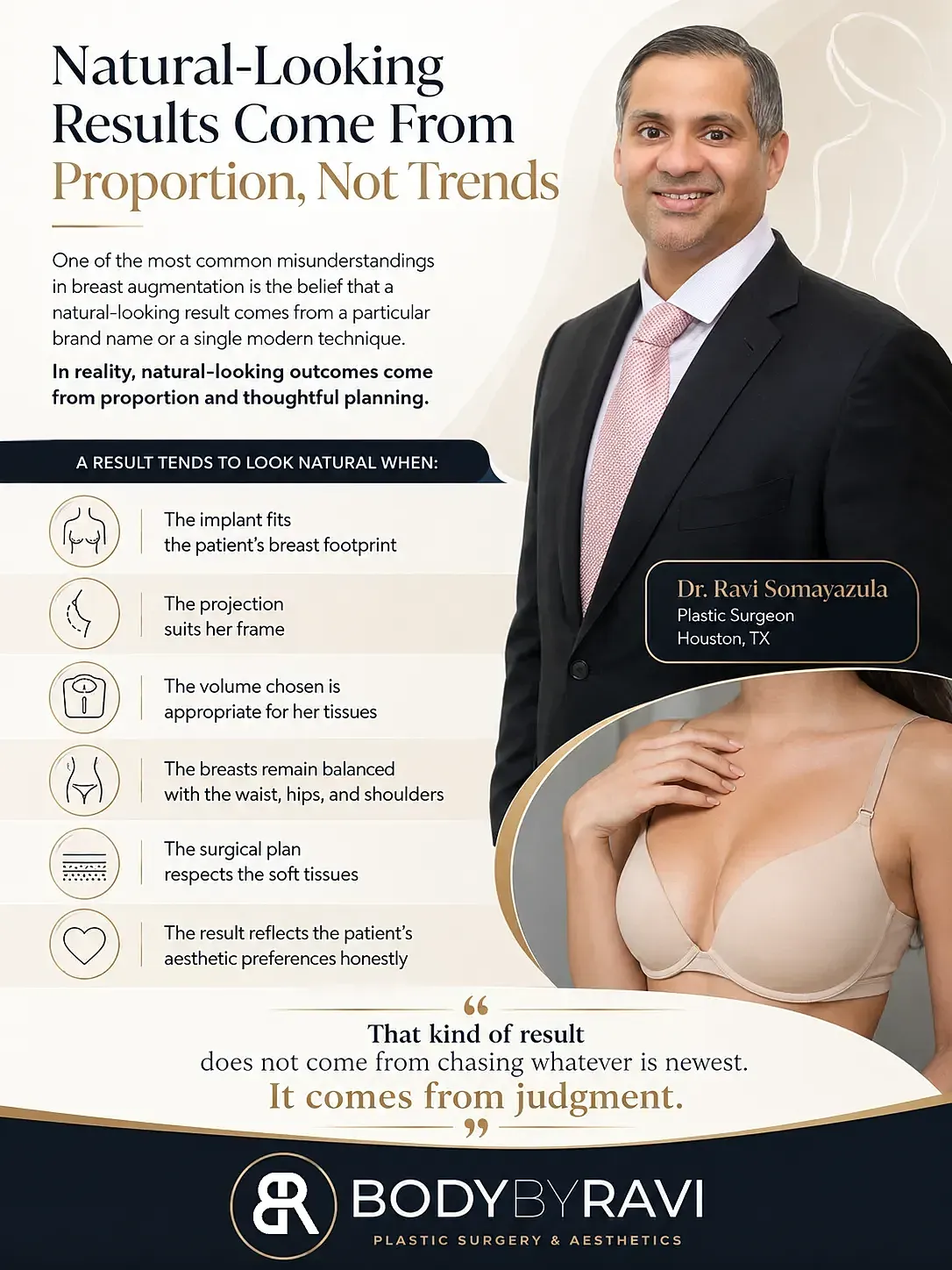
A result tends to look natural when:
That kind of result does not come from chasing whatever is newest. It comes from judgment.
Natural-looking also does not mean everyone should choose a very small implant. Some patients want more visible fullness, and when planned properly, that can still look proportionate and elegant on their body. The point is not to make every patient look understated. The point is to make every patient look balanced.
That is central to Dr. Ravi’s philosophy. He does not believe in using a trend-based formula for every patient. He believes in understanding what the patient wants, evaluating what her anatomy can support, and then creating a result that looks intentional, feminine, and natural on her specific frame.
One of the reasons this topic cannot be simplified is that breast augmentation patients come in with very different motivations.
Some are looking to restore what pregnancy changed. They may have once felt very comfortable with their breasts and now simply want their pre-pregnancy fullness back.
Some have experienced weight loss and feel their breasts no longer match the rest of their body. After putting in the effort to improve their health, they may want their breast shape to feel more balanced and complete.
Some were simply born with small breasts and have carried that insecurity quietly for years. For them, augmentation is not about chasing an ideal. It is about finally addressing something they have wanted to change for a long time.
Some want only a subtle enhancement. Others want more visible shaping and upper-pole fullness. Some care deeply about gym performance and chest movement. Others care most about silhouette, clothing fit, and femininity.
Because of this range, the right recommendation may look very different from one woman to the next. That is why careful consultation matters more than generalized internet comparisons.
No matter which technique is chosen, implant-based breast augmentation still requires informed decision-making and long-term perspective. Breast implants are not lifetime devices. Patients should understand that future monitoring, imaging, or revision surgery may eventually become part of their care.
They should also understand that breast implant surgery carries real considerations, including:
A balanced consultation does not ignore these points, and it does not use the appeal of innovation to downplay them. Patients deserve a clear understanding of both the benefits and the responsibilities that come with implants.
Dr. Ravi believes that transparency builds trust. Patients should feel informed, not pressured. They should understand why a recommendation is being made and how it fits their anatomy, priorities, and long-term expectations.
Many patients assume it is a “better” or safer version of breast augmentation for everyone. In reality, it is simply a different approach that may work well for selected anatomy and goals but is not universally superior.
Natural feel depends more on tissue thickness, implant size, and surgical planning than the technique alone. In the right patient, Motiva Preserve may support a softer feel, but traditional techniques can also achieve very natural results.
It may appeal to active patients who are concerned about chest muscle involvement. However, the best approach still depends on anatomy and goals, not just activity level.
No breast implant technique eliminates the possibility of future procedures. Patients should still expect long-term monitoring and understand that implants are not lifetime devices.
It is not designed to replace a breast lift. If there is true drooping of the nipple or excess skin, a lift may still be necessary to achieve a balanced result.
It is generally better suited for modest to moderate enhancements. Patients seeking a larger size increase may be better served with a more traditional augmentation approach.
Scar quality depends more on incision placement, healing, and surgical technique than the specific method used. Both approaches can result in well-concealed scars when planned carefully.
Some patients may experience a smoother early recovery, but pain levels vary widely from person to person. Surgical planning and postoperative care often play a larger role than the technique name itself.
No technique completely removes the risk of complications. Careful surgical technique, sterility, and patient factors all contribute to outcomes regardless of the approach used.
The decision can only be made through a detailed consultation that evaluates anatomy, tissue quality, and goals. A personalized plan is essential to determine whether it is the right fit or if another approach would provide a better result.
Published
3 minute read
Patients in Houston often want a result that feels polished, sophisticated, and attractive without looking exaggerated. They want to feel more confident in fitted clothing, swimwear, and day-to-day life, but they also want a result that still feels like them.
That is why many local patients respond well to a consultation style that feels calm, individualized, and precise. They do not want a sales pitch. They want a recommendation. They want a surgeon who can explain when a newer technique may be a good fit and when a more traditional approach may actually lead to the better result.
At Body by Ravi Plastic Surgery & Associates, that is exactly how the conversation is approached. The patient experience is elevated and personal, but it is grounded in substance. Comfort matters. Luxury matters. But the foundation remains surgical judgment, safety, careful planning, and honest communication.
Motiva Preservé is an interesting and important development in modern breast enhancement. For the right patient, it may offer a thoughtful, tissue-conscious option that aligns beautifully with goals such as subtle enhancement, softness, and a more recovery-aware approach. Traditional breast augmentation techniques remain just as important because they continue to provide versatility, adaptability, and excellent aesthetic possibilities for a much broader range of patients.
The decision should never come down to which term sounds more exciting. It should come down to what suits the patient’s body, lifestyle, and goals most appropriately.
That is how Dr. Ravi approaches breast augmentation. He focuses on proportion, anatomy, safety, patient education, and long-term aesthetic harmony. He understands that some women may be ideal candidates for Motiva Preservé, while others may achieve a better outcome through a traditional augmentation technique or a more customized combination plan.
For women in Houston considering breast enhancement, the most valuable next step is a personalized consultation at Body by Ravi Plastic Surgery & Associates. That conversation can help clarify what is realistic, what is appropriate, and what type of surgical plan is most likely to create the natural-looking, balanced, and confidence-building result they are truly seeking.