 (281) 242-1061
  Schedule Consultation

Published
12 minute read
Losing a significant amount of weight is a major achievement. It often reflects months or years of discipline, sacrifice, consistency, and a genuine commitment to better health. For some women, that journey follows pregnancy. For women and men, it follows bariatric surgery, physician-guided weight loss, or a major lifestyle change that finally brought the scale in the right direction. No matter how the transformation happens, the emotional expectation is often the same. Patients hope that once the weight comes off, their body will finally look and feel the way they imagined.
But for many people, weight loss is only part of the story.
After the body becomes smaller, the skin and supporting tissues do not always retract in a smooth or youthful way. Instead, loose skin can remain across the abdomen, flanks, lower back, buttocks, and thighs. The body may feel healthier and lighter, but still not look settled. Clothing may fit better in some ways and worse in others. Exercise may become easier, yet excess skin can still rub, fold, hang, or create discomfort. Patients often describe feeling proud of their progress and frustrated at the same time.
That is where body contouring enters the conversation.
For patients in Houston considering surgery after weight loss, one of the most important questions is whether a tummy tuck or a lower body lift is the better choice. These procedures are related, but they are not the same. They address different patterns of skin laxity, different contour problems, and different goals. Choosing correctly matters because the right operation can create a balanced and satisfying result, while the wrong operation can leave patients improved in one area but under-corrected in another.
Dr. Ravi Somayazula, Plastic Surgeon in Houston, TX approaches this decision with careful attention to anatomy, proportion, and long-term outcome. In his philosophy, surgery should not be selected because it is the most commonly known name or because it sounds simpler in theory. It should be selected because it matches the patient’s body and addresses the actual problem in a thoughtful, safe, and individualized way.
Patients are often surprised by how much body shape can change after weight loss without necessarily becoming tighter. Many expect that if they keep losing weight, the skin will eventually catch up. In reality, skin elasticity has limits. Once tissue has been stretched for a long time, whether by pregnancy, weight gain, or repeated fluctuations, the skin may not shrink back completely after the volume is gone.
This is not a failure on the patient’s part. It is biology.
Collagen and elastin do not always rebound the way people hope. Age, genetics, the amount of weight lost, the length of time the body carried extra weight, and the condition of the skin all play a role. That is why some patients lose a moderate amount of weight and still have a lower abdominal apron, while others who lose a very large amount of weight develop circumferential skin laxity all the way around the lower torso.
The result can be more than cosmetic. Excess skin may affect:
This is particularly true for patients who have worked incredibly hard to change their lives. They may be healthier than they have been in years, but still feel disconnected from the body they see in the mirror.
At Body by Ravi Plastic Surgery & Associates, this stage of the journey is treated with respect. Dr. Ravi understands that post-weight-loss body contouring is not just about appearance. For many patients, it is about resolution. It is about helping the body look more aligned with the effort, discipline, and progress that already took place.
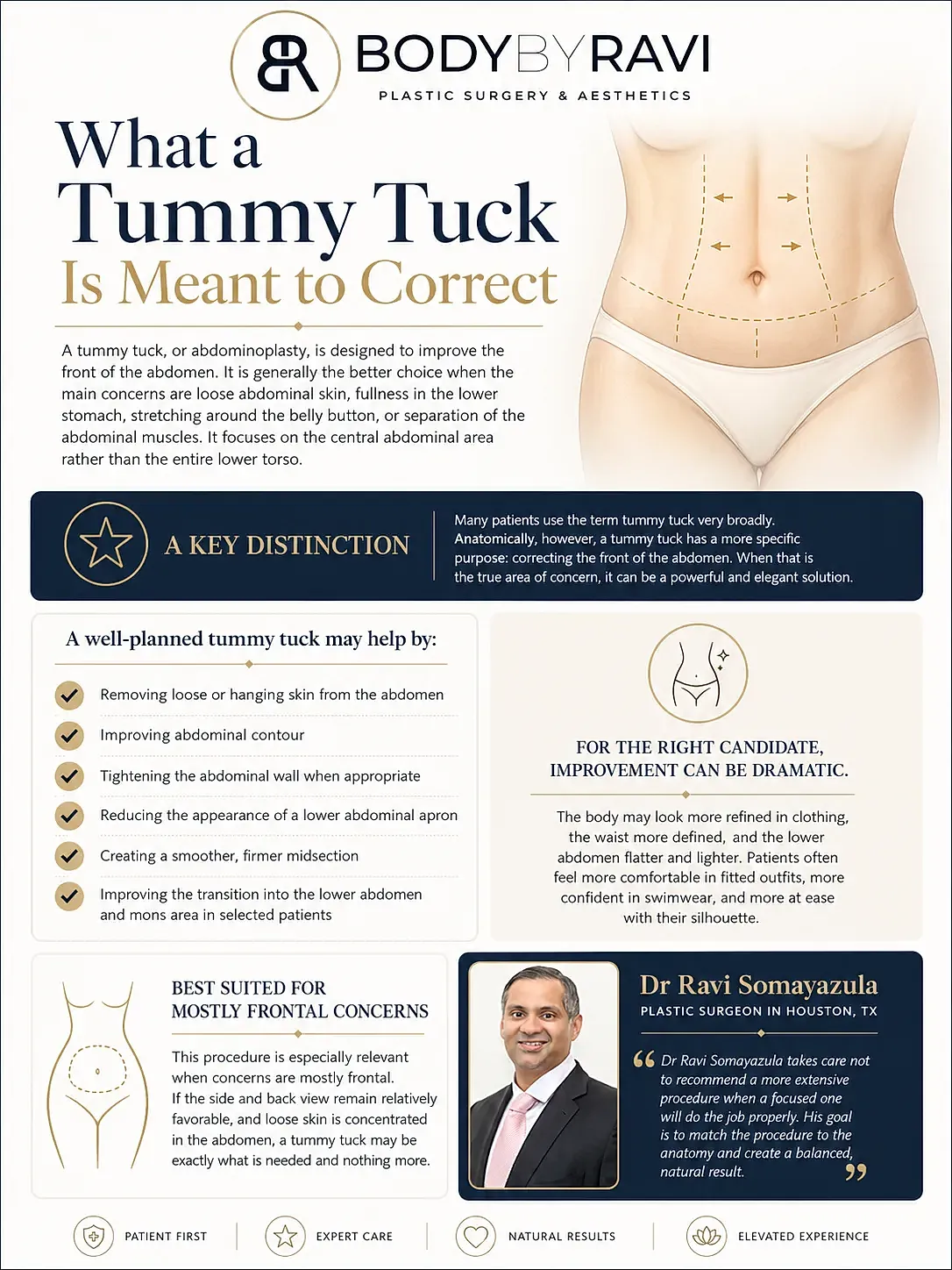
A tummy tuck, or abdominoplasty, is designed to improve the front of the abdomen. It is generally the better choice when the main concerns are loose abdominal skin, fullness in the lower stomach, stretching around the belly button, or separation of the abdominal muscles. It focuses on the central abdominal area rather than the entire lower torso.
This is one of the most important distinctions in the conversation.
Many patients use the term tummy tuck very broadly. They may use it to describe almost any body contouring procedure involving the waist or midsection. Anatomically, however, a tummy tuck has a more specific purpose. It is intended to correct the front of the abdomen. When that is the true area of concern, it can be a powerful and elegant solution.
A well-planned tummy tuck may help by:
For the right candidate, the improvement can be dramatic. The body often looks more refined in clothing. The waist can appear more defined. The lower abdomen can feel flatter and lighter. Patients frequently describe feeling more comfortable in fitted outfits, more confident in swimwear, and more at ease with their overall silhouette.
This procedure is especially relevant for patients whose concerns are mostly frontal. If the side and back view remain relatively favorable, and the loose skin is concentrated in the abdomen, then a tummy tuck may be exactly what is needed and nothing more.
Dr. Ravi Somayazula, Plastic Surgeon in Houston, TX takes care not to recommend a more extensive procedure when a focused one will do the job properly. His goal is not to overoperate. His goal is to match the procedure to the anatomy and create a result that looks balanced, natural, and appropriate for that individual patient.
A lower body lift is a more comprehensive body contouring procedure. Rather than treating only the front of the abdomen, it addresses the lower torso in a circumferential or 360-degree way. That means it can improve the abdomen, flanks, lower back, outer hips, and buttock region.
This makes it particularly important for patients after major weight loss.
Many post-weight-loss patients do not only have loose skin in the front. Their laxity wraps around the waist. The lower back may have folds or draping tissue. The buttocks may look flattened, deflated, or low. The hips may appear less supported. In these cases, a tummy tuck alone can improve the front view, but the overall shape may still feel incomplete from the side and back.
A lower body lift is designed to address that broader pattern.
It may help improve:
For the right patient, this can be transformative because it treats the problem where it truly exists. It does not simply flatten the front. It reshapes the lower body more completely.
That difference matters. A patient may look at the mirror and think they need their stomach fixed, when in reality the issue extends well beyond the stomach. This is why surgical planning after weight loss should never be reduced to a trend, a social media phrase, or a familiar procedure name. The body has to be evaluated as a whole.
Sometimes the clearest explanation is also the most helpful.
Another way to think about it is this:
That does not mean one procedure is better than the other overall. It means one may be better for a specific body. Patients often feel relieved when the conversation is framed this way because it replaces vague marketing language with anatomy-based clarity.
There are many patients who lose weight and do not need a lower body lift. That point matters because not every patient with loose skin requires the most extensive operation available. Some patients are much better suited to a tummy tuck, especially when the problem is primarily abdominal.
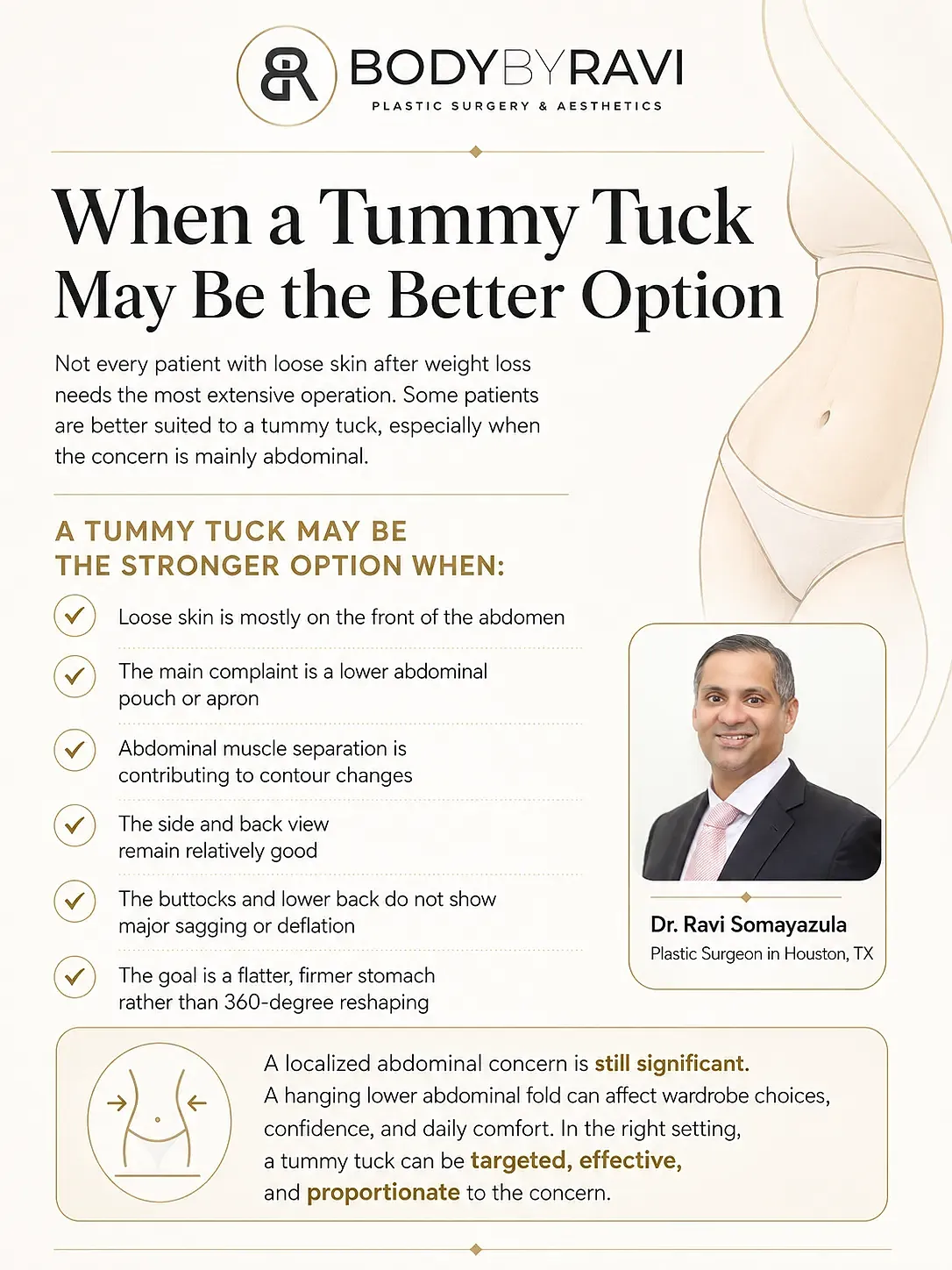
A tummy tuck may be the stronger option when:
These patients may still be significantly bothered by their abdomen. The fact that the concern is localized does not make it minor. A hanging lower abdominal fold can affect wardrobe choices, confidence, and comfort in daily life. It can also create a constant reminder of a former body shape that no longer reflects the patient’s health or effort.
In the right setting, a tummy tuck can be the perfect procedure because it is targeted, effective, and proportionate to the concern.
A lower body lift often becomes the more appropriate choice when the effect of weight loss is visible from every angle. These are the patients who often say they feel improved, but not finished. The loose skin does not stop at the abdomen. It continues around the waistline and into the lower back and buttocks.
That pattern often includes:
For these patients, the issue is not simply extra skin in one place. It is a loss of structural harmony throughout the lower body. A lower body lift can provide a more complete correction because it addresses the whole contour relationship between the abdomen, waist, lower back, and buttocks.
Dr. Ravi Somayazula, Plastic Surgeon in Houston, TX understands how important this is after massive weight loss. He knows that many patients are not looking for an exaggerated or artificial appearance. They are looking for their hard-earned weight loss to make sense visually. They want smoother lines, better support, and a result that feels complete rather than partial.
It is natural for patients to ask whether they can choose the less extensive procedure. Most people want the best result with the least recovery, the shortest scar, and the simplest process. That is completely understandable.
But in post-weight-loss contouring, smaller is not always better if it does not solve the real problem.
A patient with circumferential laxity may request a tummy tuck simply because that is the name they know. If the true issue includes the flanks, lower back, and buttocks, limiting surgery to the abdomen may leave them under-corrected. The front may look better, but the overall shape may still feel unfinished. In some cases, this can lead to disappointment, not because the tummy tuck was performed poorly, but because it was not the ideal procedure for the anatomy.
That is where honest consultation matters.
Dr. Ravi is known for a calm and personable consultation style. He listens carefully, explains clearly, and guides patients through the reasoning behind each recommendation. He does not make decisions based on trends or pressure. He makes them based on anatomy, safety, proportion, and what is most likely to produce the best long-term result.
Sometimes that means confirming that a tummy tuck is exactly right. Sometimes it means explaining that a lower body lift will more fully address the concern. That kind of honesty builds trust and helps patients move forward with greater confidence.
Another important part of this conversation is liposuction. Many patients wonder whether liposuction alone can address their concerns after weight loss. The answer depends on what is causing the shape issue.
Liposuction treats excess fat. It does not remove significant loose skin. If the skin quality is still good and the concern is mostly stubborn fat deposits, liposuction may help. But if the true problem is hanging skin, tissue redundancy, or circumferential laxity, liposuction alone will not usually be enough.
That said, liposuction can still play an important supporting role. In selected patients, it can help refine transitions, contour the waist, and enhance the overall result when combined with a tummy tuck or lower body lift. It is not a substitute for excisional surgery when the skin is the problem, but it can be a valuable complement.
This is part of Dr. Ravi’s more sophisticated approach to contouring. The goal is not simply to make a patient smaller. The goal is to create a smoother, more harmonious body shape with natural-looking proportions.


Published
3 minute read
Post-weight-loss surgery is about more than removing skin. Several other factors matter in creating the right plan and achieving a good outcome.
Not all loose skin behaves the same way. Some patients have thin, fragile skin with less recoil. Others have thicker tissue with different healing characteristics. Skin quality influences what type of contouring will provide the most support and the best final shape.
Many bodies after weight loss do not just become smaller. They become deflated. This is especially noticeable in the buttocks, hips, and lower torso. Deflation affects the overall contour and is one reason some patients need more than just abdominal tightening.
Patients generally do best when they are at or near a stable weight. Ongoing weight changes after surgery can affect the result and the longevity of the contour.
Healing requires preparation. Patients who have undergone major weight loss, especially after bariatric procedures, may need closer attention to nutrition and overall readiness before surgery.
Support at home, time away from work, activity restrictions, compression, and follow-up care all play an important role in the experience. Recovery is not just a side note. It is part of the outcome.
A beautiful body contouring plan is only part of the process. Recovery deserves just as much respect.
A tummy tuck recovery can be very manageable for the right candidate, but it still requires preparation and patience. Patients need to protect the repair, follow instructions carefully, and allow the body time to heal. If muscle tightening is part of the procedure, early tightness can be more noticeable.
A lower body lift recovery is often more involved because more of the lower torso has been treated. Patients need to plan more intentionally for assistance at home, limited movement in the early phase, and a realistic timeline for returning to normal activities.
This does not mean patients should be fearful. It means they should be informed.
At Body by Ravi Plastic Surgery & Associates, recovery is treated as part of the care, not an afterthought. Dr. Ravi’s patient-centered approach emphasizes clear expectations, thoughtful planning, and a structured healing process. Patients often value that level of support because they have already spent so much energy transforming their health and want the surgical phase to feel organized, safe, and carefully guided.
Dr. Ravi Somayazula, Plastic Surgeon in Houston, TX believes that the patient experience should reflect professionalism, accountability, and compassion from beginning to end. That philosophy is especially important in body contouring after weight loss, where the surgery represents a meaningful milestone in a much larger personal journey.
Some minor skin retraction can occur over time, especially in younger patients with good skin quality. However, significant excess skin after major weight loss typically does not resolve without surgery.
Weight gain after surgery can still occur and may affect the contour. Maintaining a stable weight helps preserve results, but surgery does not make future changes inherently worse if managed well.
Yes, stretch marks can sometimes guide planning. In a tummy tuck, stretch marks located on the lower abdomen may be removed, while others may be repositioned depending on skin excision.
In some patients, a lower body lift can create a lifted appearance by repositioning existing tissue. However, it does not add volume, so the degree of projection depends on the patient’s natural tissue.
Yes, patients often notice that a tummy tuck improves how clothing fits in the front, while a lower body lift can improve how clothing fits all the way around the waist and hips.
Some patients with circumferential laxity may feel that a tummy tuck alone did not fully address their concerns. This is why proper evaluation and procedure selection are so important from the beginning.
A tummy tuck that includes muscle tightening may provide a feeling of improved core support. While not a substitute for exercise, some patients report better posture awareness after healing.
Yes, in certain cases procedures can be staged for safety, recovery, or personal preference. This approach may be discussed depending on the patient’s anatomy and overall surgical plan.
The natural aging process continues after surgery. However, starting from an improved contour may still allow patients to maintain a more balanced appearance over time.
When carefully planned, results are designed to look proportionate and natural rather than exaggerated. The goal is typically to restore harmony to the body, not to create an artificial appearance.
Published
3 minute read
This topic is not only about anatomy. It is also about identity, confidence, and closure.
Many patients have spent years feeling uncomfortable in their body. They may remember hiding under certain clothes, avoiding photographs, or postponing activities until they felt more comfortable with themselves. Weight loss often changes health in powerful ways, but loose skin can still leave patients feeling stuck between the old version of themselves and the new one they worked so hard to become.
When the right procedure is chosen, the change can feel profound.
Patients often describe benefits such as:
For some, the result is practical. For others, it is deeply emotional. They feel more aligned with themselves. They feel that their reflection finally makes sense.
That is why this decision deserves care. It is not about choosing the most dramatic operation. It is about choosing the operation that truly fits the body and supports the patient’s goals in an honest and realistic way.
When deciding between a tummy tuck and a lower body lift after weight loss, the key question is not which procedure sounds more appealing in theory. The key question is where the problem truly exists.
If the concern is mainly in the front of the abdomen, a tummy tuck may be the right solution.
If the concern extends around the waist, lower back, hips, and buttocks, a lower body lift may offer the more complete correction.
There is no universal answer, and that is exactly why careful consultation matters. The best plan is based on anatomy, tissue quality, weight stability, recovery goals, and the overall vision for the result. It should never be rushed, generalized, or reduced to a simple label.
For patients in Houston and surrounding areas, this decision can become much clearer with an individualized evaluation. Dr. Ravi Somayazula, Plastic Surgeon in Houston, TX approaches post-weight-loss body contouring with the calm, empathetic, and detail-oriented perspective patients need when making an important decision about their body.
At Body by Ravi Plastic Surgery & Associates, the goal is not simply to remove skin. It is to restore harmony, improve proportion, and help patients feel that their hard-earned transformation is finally reflected in the mirror. For women and men who have worked to lose weight and are now ready to address the remaining excess skin, the right surgical plan can help bring that journey to a more complete and satisfying close.