 (281) 242-1061
  Schedule Consultation

Published
10 minute read
High and low cheekbones are normal variations in facial anatomy, and neither type is automatically more attractive, youthful, or desirable. What people perceive as “high” or “low” cheekbones depends on the location of the zygomatic bones, facial width, projection, soft-tissue volume, skin thickness, and how the cheeks relate to the eyes, temples, nose, chin, and jawline.
Dr. Mathew Moreno evaluates cheek structure as part of the entire face rather than treating cheekbone height as an isolated feature. His approach emphasizes proportion, restraint, and preserving facial identity, especially when aging, weight loss, or soft-tissue descent changes how the underlying cheek structure is perceived.
The cheekbones are formed primarily by the zygomatic bones, which create part of the skeletal framework beneath the eyes and along the outer midface. They influence facial width, projection, light reflection, and the transition between the lower eyelids and cheeks.
Visible cheek contour is not created by bone alone. Fat compartments, muscles, retaining ligaments, skin thickness, and inherited facial proportions all contribute to whether the cheeks appear sharp, soft, broad, flat, high, or low.
Cheekbones help:
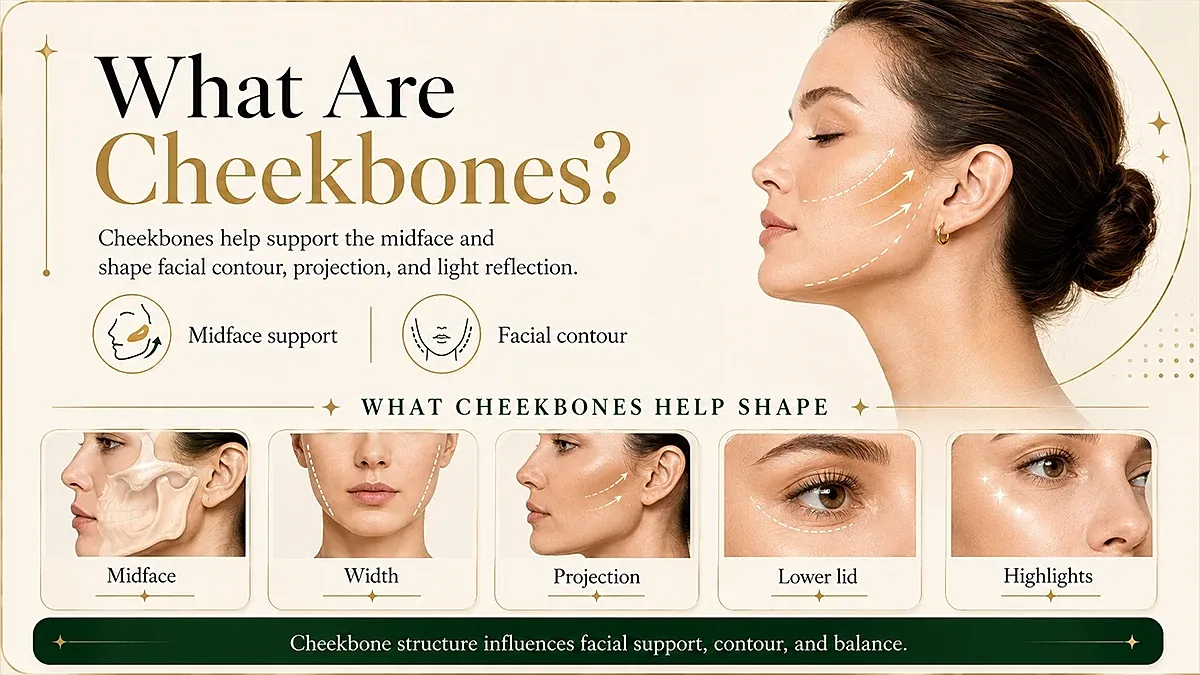
High cheekbones have their most noticeable prominence closer to the lower eyelids and upper outer cheeks. They often create stronger upper-midface definition and a more visible transition between the cheek, temple, and lower face.
High cheekbones do not always create an angular face because the overlying soft tissues can soften the underlying structure. Dr. Moreno considers both the skeleton and the tissue covering it before deciding whether volume restoration or another facial treatment would improve balance.
Common characteristics include:
Low cheekbones have their most visible prominence farther down the midface. They may create a softer transition between the upper cheek and lower face, although facial width and soft-tissue volume strongly influence how they appear.
Low cheekbones are a normal anatomical pattern rather than a defect. A person can have lower-set cheek prominence and still have excellent facial balance, strong definition, and attractive proportions.
They may be associated with:
No. High and low cheekbones describe anatomical differences rather than different levels of attractiveness or facial quality. Both can look proportionate and aesthetically balanced.
Dr. Moreno focuses on harmony between facial features rather than trying to reproduce a fashionable cheek shape. The cheeks should complement the eyes, nose, lips, chin, jawline, and overall identity of the patient.
Important considerations include:
Cheekbone position can be estimated by locating the area of greatest bony prominence between the lower eyelid and jaw. If the prominence sits closer to the eyes, the cheekbones may be considered higher; if it sits farther down the face, they may be considered lower.
A professional assessment is more reliable because visible fullness may come from fat, skin, muscle, or swelling rather than the underlying bone. Dr. Moreno evaluates the face from the front, profile, and three-quarter views before drawing conclusions about cheek anatomy.
Assessment may include:
Cheekbone anatomy influences the framework of the midface, but it is only one part of facial aging. Changes in skin, fat compartments, ligaments, muscle, and the facial skeleton all contribute to how the cheeks change over time.
Dr. Moreno evaluates whether the apparent change comes from volume loss, tissue descent, lower-eyelid aging, skin quality, or skeletal proportions. This matters because adding volume to the wrong problem can create heaviness instead of rejuvenation.
Facial aging may involve:
High cheekbones may become more visually prominent as surrounding facial volume decreases. In some patients, this can make the temples, under-eye area, or lower cheek appear more hollow.
The appropriate treatment is not necessarily to add more volume directly over the cheekbone. Dr. Moreno may instead restore smooth transitions between facial regions or leave an already balanced cheek structure untreated.
Changes may include:
Low cheekbones do not create one predictable aging pattern, but some patients develop flatter midface contours, deeper facial folds, or increased visual weight in the lower face. Soft-tissue descent can make the cheek appear even lower over time.
Dr. Moreno determines whether the problem is true volume loss or structural descent before recommending treatment. Simply adding volume to a descended cheek can widen or weigh down the midface.
Possible changes include:
Yes. Midface width and cheek projection influence how the lower face and jawline are perceived. A narrower midface may make the jaw appear relatively broader, while stronger cheek projection can change the overall facial silhouette.
Dr. Moreno evaluates the cheeks together with the chin, jawline, lower face, and neck because these areas visually influence one another. Improving one region without considering the others can create disproportion.
Cheek structure can affect:
Yes. Facial fat grafting can restore selected cheek volume using fat harvested from another area of the patient’s body. It is especially useful when aging or significant weight loss has created midface deflation rather than a problem with the underlying bone.
Dr. Moreno uses facial fat grafting as part of his facial rejuvenation approach and emphasizes conservative placement. The goal is to restore softness and support without making the cheeks look overfilled or disproportionately wide.
Potential benefits include:
Yes. Dermal filler can temporarily increase cheek projection or restore selected areas of volume in appropriately selected patients. It works by adding volume rather than changing the underlying bone.
Filler should be planned conservatively because excessive or poorly positioned volume can make the midface appear broad, heavy, or unnatural. Patients considering filler should be assessed by an appropriately qualified medical professional with detailed knowledge of facial anatomy.
Cheek filler may:
Cheek filler may create a visual impression of support, but it does not reproduce the structural effect of a facelift. Its primary action is adding volume and changing surface contour.
Patients with meaningful tissue descent or jowling may not benefit from repeatedly adding volume to the cheeks. Dr. Moreno evaluates whether structural lifting, fat restoration, or no treatment would provide a more natural result.
Filler cannot fully:
Cheek filler can cause swelling, bruising, tenderness, asymmetry, lumps, or temporary contour irregularities. Less common complications include infection, persistent swelling, nodules, inflammatory reactions, and tissue injury.
The most serious complication is accidental injection into a blood vessel, which can impair circulation and cause skin injury or, rarely, visual or neurological complications. Appropriate training, anatomical knowledge, and rapid recognition of vascular complications are essential.
Potential risks include:
The cheek and lower-eyelid region can develop prolonged swelling in some patients, especially when product is placed near areas involved in lymphatic drainage.
Previous filler, product characteristics, injection plane, skin quality, and individual anatomy may influence this risk. Patients with existing lower-eyelid puffiness require especially careful assessment before additional volume is placed.
Persistent swelling may relate to:
Surgery may be more appropriate when the primary concern is significant cheek descent, jowling, lower-face laxity, or structural aging rather than volume loss alone. Adding filler or fat to advanced tissue descent can sometimes make the face appear heavier.
Dr. Moreno’s extended deep plane facelift approach is designed to release and reposition descended facial tissues rather than simply camouflage them with volume. Facial fat grafting may then be added selectively when genuine deflation remains.
Surgery may be considered for:

The lower eyelid and upper cheek form a continuous aesthetic region, so under-eye bags or hollows can alter how cheek projection is perceived. Improving this junction can make the cheeks appear smoother and better supported.
Dr. Moreno uses a transconjunctival lower blepharoplasty approach when appropriate and may incorporate conservative fat treatment or nanofat. The objective is a smooth eyelid-to-cheek transition rather than creating artificial cheek volume.
Treatment may improve:
Yes. Significant weight loss can reduce facial fat and make the underlying cheekbones appear more prominent, angular, or hollow. This may occur even when the bone itself has not changed.
Dr. Moreno specifically evaluates facial deflation after major weight loss, including weight loss associated with GLP-1 medications. Facial fat grafting may be considered when restoring volume would improve balance without obscuring natural bone structure.
Weight loss may cause:
Mild cheek asymmetry may sometimes be improved with facial fat grafting, filler, or another targeted treatment. The correct approach depends on whether the difference comes from bone, fat, muscle, tissue descent, or previous procedures.
Perfect symmetry is not a realistic or necessary goal because virtually every face has natural differences between the two sides. Dr. Moreno focuses on improving noticeable imbalance while preserving natural variation.
Causes may include:
Dr. Moreno evaluates cheek height, projection, facial width, tissue volume, lower-eyelid support, skin quality, and the relationship between the midface and lower face. He also considers how the cheeks appear from several viewing angles rather than relying on a frontal photograph alone.
The consultation is intended to identify what is actually causing the concern before recommending treatment. In some patients, the best recommendation may be fat grafting or surgery, while in others the most appropriate decision may be to leave naturally balanced cheekbones alone.
His assessment may include:
Yes. The relationship between the cheek and lower eyelid can create shadows that resemble fatigue, particularly when volume has been lost.
Camera angle, focal length, and directional lighting can exaggerate highlights and shadows. Three-quarter photographs often emphasize cheek projection more than a straight-on mirror view.
Yes. Makeup follows the underlying skeletal structure, so the same contour placement can create very different effects on different faces.
Volume placed too laterally or in a patient who already has adequate width can expand the visual midface. More volume does not necessarily produce more lift.
It can make the underlying skeleton more visible by reducing the soft tissue covering it. The bone has not moved, but its prominence may become more obvious.
Yes. Natural skeletal asymmetry, differences in soft-tissue volume, and even habitual facial movement can make one cheek appear more prominent.
Yes. A relatively narrow or low-projection midface can make the jaw appear broader by comparison, even when the jaw itself has not changed.
Poorly selected or excessive volume can interfere with smooth eyelid-to-cheek blending or contribute to puffiness. The lower eyelid and cheek must be assessed together.
Yes. Thick skin and fuller facial fat can soften even prominent underlying cheekbones.
Yes. Knowing whether the concern comes from bone structure, volume loss, or tissue descent can prevent treatments that add unnecessary volume or fail to address the actual problem.
Published
2 minute read
Dr. Moreno combines comprehensive plastic surgery training with advanced aesthetic fellowship experience and a focused interest in facial rejuvenation. His documented approach includes facial fat grafting, lower-eyelid rejuvenation, and extended deep plane facelift techniques that can address different causes of midface aging.
He emphasizes anatomy-based planning and natural proportions rather than treating every cheek with the same volume or shape. Patients can expect an honest discussion of whether the concern requires volume restoration, structural lifting, another treatment, or no intervention at all.
Patients may value his focus on:
Schedule a consultation if you want to understand your cheek anatomy or explore a facial contouring treatment. An examination can determine whether the concern involves bone structure, volume loss, skin quality, tissue descent, or another facial feature.
During your visit, Dr. Moreno will explain what treatment can realistically accomplish and whether it is necessary at all. Contact Body by Ravi Plastic Surgery & Associates in Houston at 281-346-9038 to request a personalized consultation.