 (281) 242-1061
  Schedule Consultation
Published
9 minute read
Excess skin removal surgery is often the final step in a long, deeply personal journey. For many women and men, it follows years of effort after weight loss, pregnancy, or major lifestyle changes. The goal is not perfection. It is comfort, confidence, and feeling at home in one’s body again.
While body contouring after weight loss can be transformative, recovery is not always straightforward. Healing unfolds in stages, and along the way, patients may notice changes they were not expecting. One of the most common and most misunderstood of these changes is something surgeons call “dog ears.”
Dog ears are frequently searched online and rarely explained well. When patients first notice them, they may worry that something went wrong or that their result is permanent. In reality, dog ears are a known, manageable part of excess skin removal surgery. Understanding what they are, why they occur, and how they are treated can make a significant difference in how patients experience recovery.
At Body by Ravi Plastic Surgery & Associates in Houston, Texas, education is considered part of the surgical process. Dr. Ravi Somayazula believes that patients heal best when they understand what their body is doing and why.
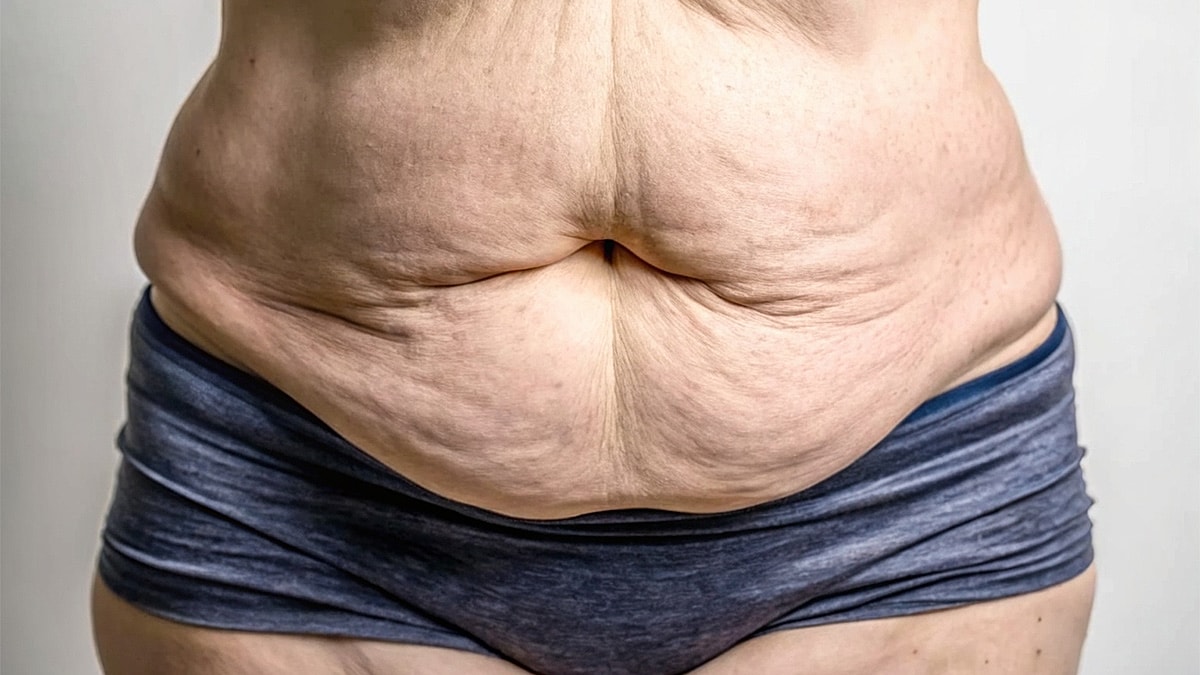
Skin is a living organ with remarkable flexibility, but it is not limitless. When the skin stretches gradually, as it does during pregnancy or weight gain, it relies on elastic fibers to return to its original shape. Over time, those fibers can weaken or break.
After significant weight loss, especially rapid or large-volume weight loss, the skin often cannot retract fully. This is not a failure of discipline or fitness. It is biology.
Excess skin can cause more than aesthetic concerns. Many patients experience discomfort, irritation, hygiene challenges, rashes, and difficulty exercising or wearing certain clothing. Emotionally, excess skin can feel like a reminder of a chapter they are trying to move beyond.
Surgical skin removal is designed to address both physical and emotional burdens. Procedures such as tummy tuck surgery, body lift, arm lift, thigh lift, and breast surgery reshape the body by removing redundant skin and tightening underlying tissues.
However, because the human body is curved and three-dimensional, certain contour variations can occur during healing. Dog ears are one of the most common.
The term “dog ears” refers to small folds or puckers of skin that appear at the ends of a surgical incision. Instead of lying flat, the skin may protrude slightly, creating a rounded or bunched appearance.
Despite the informal name, dog ears are not unusual. They can occur after any procedure that involves removing a significant amount of skin and closing a long incision.
Dog ears may be visible immediately after surgery or become noticeable as swelling decreases. In some cases, they soften and resolve on their own. In others, they persist and may require further evaluation.
What is important for patients to understand is that dog ears are not inherently dangerous, and they are not automatically a sign of poor surgery.
Dog ears are largely a matter of geometry and tissue behavior.
When skin is removed, the remaining skin must be brought together under tension. If the amount of skin removed is not perfectly uniform along the incision, or if the surrounding tissue thickness varies, the skin can bunch at the ends. This is especially true in areas where the body curves, such as the hips, waist, arms, or thighs.
Several factors influence whether dog ears develop:
In many cases, completely eliminating the possibility of dog ears would require extending the incision further. That trade-off is not always desirable.
This is one of the most common concerns patients express, and it deserves a clear answer.
Dog ears are not automatically a surgical mistake. They are a known potential outcome of skin removal surgery. Experienced plastic surgeons anticipate where dog ears may form and plan accordingly.
There is often a balance between achieving the smoothest possible contour and keeping scars as short and well-placed as possible. Extending an incision can flatten a contour, but it also increases scar length and visibility. For many patients, a slightly shorter scar with the possibility of a small dog ear is preferable to a much longer scar.
Dr. Ravi Somayazula, Plastic Surgeon in Houston, TX, approaches this balance with intention. His goal is not to chase a technical ideal at the expense of the patient’s long-term satisfaction. Decisions are made collaboratively, with transparency and careful explanation.
Some patients have a higher likelihood of developing dog ears due to anatomy or surgical context.
Patients who have lost a large amount of weight often have more extensive skin redundancy and variations in tissue thickness. Areas where thicker tissue meets thinner tissue are more prone to contour irregularities.
Dog ears are also more common in areas with natural curves, such as the lateral abdomen, underarms, and upper thighs. Skin quality plays a role as well. Skin with reduced elasticity may not adapt as smoothly during closure.
These factors are not within a patient’s control. They are part of individual anatomy and healing biology.
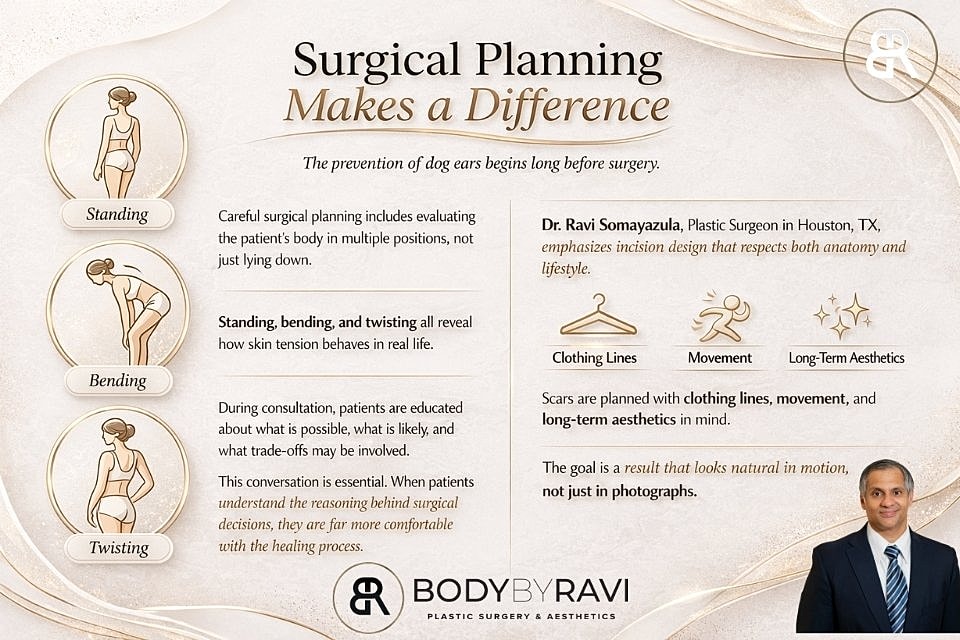
The prevention of dog ears begins long before surgery.
Careful surgical planning includes evaluating the patient’s body in multiple positions, not just lying down. Standing, bending, and twisting all reveal how skin tension behaves in real life.
Dr. Ravi Somayazula, Plastic Surgeon in Houston, TX, emphasizes incision design that respects both anatomy and lifestyle. Scars are planned with clothing lines, movement, and long-term aesthetics in mind. The goal is a result that looks natural in motion, not just in photographs.
During consultation, patients are educated about what is possible, what is likely, and what trade-offs may be involved. This conversation is essential. When patients understand the reasoning behind surgical decisions, they are far more comfortable with the healing process.
Not everything that looks like a dog ear in the early postoperative period is permanent.
Swelling is expected after surgery. Fluid shifts, inflammation, and tissue remodeling all take time. In the first several weeks, it can be difficult to distinguish between temporary swelling and a true contour irregularity.
For this reason, Dr. Ravi encourages patience. The body needs time to settle. Many apparent dog ears improve significantly or disappear entirely as healing progresses.
Final contours often take several months to become fully apparent. Evaluating results too early can lead to unnecessary worry.
Not all dog ears require treatment. Many are subtle and do not bother the patient.
Intervention may be considered if a dog ear causes:
The decision to address a dog ear is always patient-centered. It is based on how the individual feels about their result, not on a rigid definition of perfection.
When correction is appropriate, it is often relatively simple.
In many cases, dog ear revision can be performed as a minor in-office procedure under local anesthesia. A small amount of excess tissue is removed, and the incision is refined to create a smoother contour.
Recovery from these revisions is typically brief, with minimal downtime and discomfort. Scars are usually small and fade well over time.
Dr. Ravi Somayazula, Plastic Surgeon in Houston, TX, views revision procedures as part of comprehensive care when needed. The goal is always to support the patient’s confidence and comfort.
Managing dog ears effectively requires experience, judgment, and restraint.
An experienced surgeon understands where tension is likely to accumulate and how skin behaves in different regions of the body. They know when to be aggressive and when to be conservative.
Overcorrection can lead to excessive scarring or healing problems. Undercorrection can leave unwanted fullness. The best results come from balance, not extremes.
Experience also allows surgeons to communicate honestly with patients about expectations. Clear communication reduces anxiety and builds trust.
Scar quality and contour quality cannot be separated. Excessive tension on an incision increases the risk of widened scars and contour irregularities.
Dr. Ravi Somayazula, Plastic Surgeon in Houston, TX, integrates scar optimization into every surgical plan. This includes layered closure techniques, tension-relieving strategies, and postoperative protocols designed to support healing.
By managing tension carefully, the risk of dog ears and unfavorable scarring is reduced simultaneously. Scar care is not an afterthought. It is part of the surgical philosophy.
At Body by Ravi Plastic Surgery & Associates, surgery is one component of a broader, patient-focused system of care.
The practice offers a multidisciplinary approach that includes surgical expertise, enhanced recovery protocols, and postoperative support through RISE Medspa. This integration allows patients to heal more comfortably and achieve more refined outcomes.
Procedures are performed in a QuadA-accredited surgical facility with a board-certified anesthesiologist and an experienced operating team. Safety, precision, and coordination are central to every case.
Physical healing is only part of recovery. Emotional healing matters just as much.
After surgery, patients may experience moments of doubt or vulnerability. The body can look unfamiliar during early healing, and swelling can obscure the final result. Without proper guidance, these changes can feel unsettling.
Dr. Ravi believes that education and communication are the antidotes to fear. Patients are supported throughout recovery with clear expectations, regular follow-up, and open lines of communication.
When patients understand that healing is a process, they are more confident navigating it.
Houston patients live active, dynamic lives. Climate, clothing choices, and year-round activity all influence surgical planning.
Dr. Ravi Somayazula, Plastic Surgeon in Houston, TX, considers these factors carefully. Incisions are placed with real-world movement and lifestyle in mind. The goal is not just a good surgical result, but a result that feels natural and functional in daily life.
Yes. Early dog ears can feel firm due to internal swelling and healing tissue rather than excess skin. This firmness often softens over several weeks as inflammation resolves.
Yes. Dog ears can appear more prominent in certain positions, especially when sitting or bending, because skin tension changes with movement. This is why they are evaluated in multiple positions, not just standing still.
No. Dog ears are related to how skin closes and heals, not whether enough skin was removed. In many cases, they represent a normal trade-off between scar length and contour.
Yes. Weight gain or loss can change tissue fullness around incision ends and make dog ears more noticeable. Maintaining a stable weight after surgery helps preserve contour results.
As swelling decreases, underlying contour irregularities can become more visible. This delayed appearance does not mean something new has gone wrong, only that healing is progressing.
In some cases, gentle compression and time can help swelling settle and improve mild contour irregularities. Massage should only be done if specifically recommended by the surgeon.
They can be. Revision surgery often involves scar tissue and altered blood supply, which can affect how skin closes and heals at incision edges.
Yes. Even subtle dog ears can rub against waistbands or armholes and cause irritation or self-consciousness. Functional concerns are just as important as visual ones when deciding on treatment.
Recurrence is uncommon when correction is done after full healing and weight is stable. Long-term results depend on skin quality and postoperative care.
Because experience teaches that transparency builds trust. Surgeons who address dog ears upfront understand they are part of real anatomy, not something to avoid discussing.
Published
2 minute read
Excess skin removal surgery is not about chasing perfection. It is about restoring comfort, balance, and confidence.
Choosing a surgeon who values education, transparency, and individualized planning makes a meaningful difference. Patients should feel heard, informed, and supported from consultation through recovery.
Dr. Ravi does not make decisions based on trends. His focus is on proportion, longevity, and natural results that align with each patient’s anatomy and goals.
Dog ears are a known and manageable aspect of excess skin removal surgery. They are not something patients should fear, nor are they a sign that something has gone wrong.
With thoughtful planning, experienced surgical technique, and patient-centered care, the likelihood of significant dog ears can be minimized. When they do occur, effective solutions are available.
Confidence comes from understanding. Trust comes from honest communication.
For women and men in Houston and surrounding areas considering excess skin removal surgery, a personalized consultation is the best place to begin.
To learn more about body contouring options and what to expect, patients are invited to schedule a consultation with Dr. Ravi Somayazula at Body by Ravi Plastic Surgery & Associates.
Phone: 281-346-9038
A thoughtful conversation is the first step toward feeling comfortable and confident in your body again.
Dr. Ravi Somayazula is a nationally recognized, board-certified plastic surgeon serving Houston and the surrounding communities. Known for his refined surgical technique and natural-looking results, Dr. Ravi specializes in advanced body contouring procedures, including his signature SMART Tummy Tuck.
Patients choose Dr. Ravi for his thoughtful, personalized approach and his commitment to both safety and experience. Procedures are performed in his private, nationally accredited QUAD A surgical suite alongside board-certified physician anesthesiologists, ensuring the highest level of care from consultation through recovery.
With over a decade of experience and thousands of successful outcomes, Dr. Ravi combines surgical precision with an elevated, patient-centered experience—helping each individual feel confident, informed, and beautifully themselves
YOUR NEXT STEPS TOWARD A CONFIDENT TRANSFORMATION
Choosing the right plastic surgeon is one of the most important decisions you’ll make. We encourage you to take the time to fully understand your options and feel confident in your choice.
Your consultation is a personalized, one-on-one experience designed to understand your goals and create a tailored treatment plan.
A little preparation can help you get the most out of your consultation and feel fully confident in your next steps.